


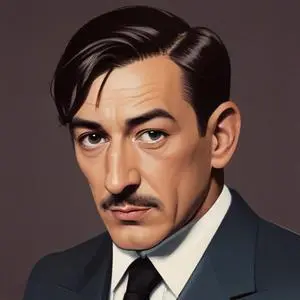
A renowned Russian musician who composed iconic symphonies and piano concertos, and was also a skilled pianist and conductor, leaving a lasting legacy in classical music.
Sergei Rachmaninoff is widely regarded as one of the most skilled pianists of all time, and his compositions continue to mesmerize audiences with their lush, sweeping melodies and complex harmonies. With a career spanning over five decades, Rachmaninoff's contributions to classical music are immense, earning him a revered place among the giants of Russian Romanticism.
Born into a family of modest means on April 1, 1873, Rachmaninoff's life was steeped in music from the very beginning. His mother, a skilled pianist, noticed his prodigious talent at the tender age of four and began teaching him the intricacies of the piano. This early start paved the way for a lifelong passion that would take him to the esteemed Moscow Conservatory, where he would study under the guidance of renowned composers Anton Arensky and Sergei Taneyev.
Rachmaninoff's compositional skills blossomed during his time at the Moscow Conservatory, where he penned several works, including his early opera, Aleko. However, his Symphony No. 1, premiered in 1897, received a devastating reception, sending the young composer into a four-year depression. It took the support of hypnotherapist Dr. Nikolai Dahl, who encouraged Rachmaninoff to explore his creative potential, for him to complete his iconic Piano Concerto No. 2 in 1901, which finally brought him the recognition he deserved.
Between 1904 and 1906, Rachmaninoff served as the conductor of the Bolshoi Theatre, further honing his skills as a master of orchestration. His subsequent relocation to Dresden, Germany, marked the beginning of an illustrious career as a pianist, with his first US tour taking place in 1909. As his fame grew, so did his travel schedule, with performances across the United States and Europe solidifying his reputation as a virtuoso pianist.
Rachmaninoff's contributions to classical music are immeasurable. His unique blend of Russian folk influences, Romantic expressiveness, and technical mastery has inspired generations of composers and musicians. His music continues to be performed and admired worldwide, with works like his Piano Concerto No. 3, Symphony No. 2, and Vocalise remaining staples of classical music repertoire.
"Music is the only occupation in which I was gifted from God. I think it's the only thing I was born for."
"If you are going to be a composer, you must be prepared to be a martyr."
Rachmaninoff received numerous honors during his lifetime, including the Gold Medal of the Royal Philharmonic Society (1932) and an honorary doctorate from the Philadelphia Academy of Music (1929).
Rachmaninoff's perseverance in the face of adversity is a testament to his dedication to his craft. Despite setbacks and self-doubt, he continued to push the boundaries of classical music, leaving behind a legacy that inspires and motivates generations of musicians and music lovers alike.
Born in 1840
A renowned Russian composer and educator, he is best known for his iconic and beloved ballets, such as Swan Lake and The Nutcracker, which continue to enchant audiences worldwide.
Born in 1839
A Russian master of evocative and dramatic music, famous for his vivid orchestral works, including the iconic "Night on Bald Mountain" and "Pictures at an Exhibition".
Born in 1882
A Russian master of music, renowned for revolutionizing classical music with bold, avant-garde compositions that blended traditional and modern elements. His iconic works, such as "The Rite of Spring," continue to inspire and influence artists across genres.
Born in 1906
A renowned Russian pianist and composer, known for blending classical music with dark humor and satire, creating iconic symphonies and film scores that still resonate today.
Born in 1770
A musical genius who expanded the possibilities of classical music, creating iconic symphonies and piano sonatas that continue to inspire and influence generations of artists.
Born in 1810
A Polish pianist and composer renowned for his delicate, expressive, and technically demanding piano music that evokes deep emotions and continues to inspire generations of musicians and music lovers. His nocturnes, waltzes, and preludes are staples of classical music.
Born in 1811
A virtuosic pianist and composer who revolutionized classical music with his technically demanding and emotionally expressive works, blending Hungarian folk influences with Romantic-era drama.
