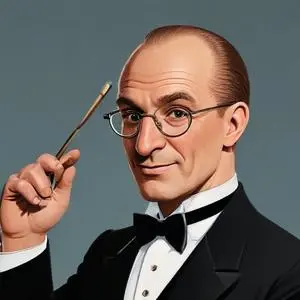
Fritz Reiner: The Maestro of Opera and Symphony
A Conductor of Note
Fritz Reiner was a renowned American conductor of opera and symphonic music in the 20th century, best known for his tenure as the music director of the Chicago Symphony Orchestra. With a career spanning over four decades, Reiner left an indelible mark on the classical music scene, earning him a place among the greatest conductors of his time.
Early Life and Education
Born on December 19, 1888, in Budapest, Austria-Hungary, Reiner came from a secular Jewish family. Initially, he pursued studies in law at his father's urging, but his passion for music soon prevailed. He enrolled at the
Franz Liszt Academy, where he studied piano, piano pedagogy, and composition under the tutelage of distinguished musicians such as Istvn Thomn, Hans Koessler, and Bla Bartk.
Rise to Prominence
Reiner's early engagements at opera houses in Budapest and Dresden (from 1914 to 1921) led to his appointment as Principal Conductor of the Cincinnati Symphony Orchestra in 1922. He remained in this position until 1931, becoming a naturalized American citizen in 1928. During this period, he also began teaching at the Curtis Institute in Philadelphia, where his students included notable composers and conductors such as
Leonard Bernstein and Lukas Foss.
A Decade of Success
Reiner's subsequent tenure as the conductor of the Pittsburgh Symphony Orchestra (1938-1948) marked a significant phase in his career. He made several recordings with the orchestra for Columbia Records, showcasing his exceptional skill and artistry. His association with the Metropolitan Opera, where he conducted a historic production of
Richard Strauss's
Salome, further solidified his reputation as a master conductor.
The Chicago Symphony Orchestra
The pinnacle of Reiner's career was his tenure as the music director of the Chicago Symphony Orchestra from 1953 to 1963. During this period, he led the orchestra to unprecedented heights, earning them international acclaim and numerous awards. His performances of works by Richard Strauss,
Gustav Mahler, and
Béla Bartók are still revered today for their interpretive insight and technical precision.
Legacy and Impact
Fritz Reiner's legacy extends beyond his impressive career milestones. He played a significant role in shaping the American classical music landscape, inspiring generations of conductors and musicians. His emphasis on technical excellence, musicality, and interpretive depth has influenced the development of many orchestras and opera companies. Today, he is remembered as one of the greatest conductors of the 20th century, leaving behind a rich cultural heritage that continues to enrich and inspire audiences worldwide.
Awards and Honors
- Grammy Award for Best Classical Performance, Opera or Choral (1960)
- Grammy Award for Best Classical Performance, Orchestra (1962)
- Honorary doctorates from Northwestern University and the University of Pennsylvania
Personal Milestones
- Married to Binka Urban (1921-1963)
- Naturalized American citizen (1928)
- Passed away on November 15, 1963, at the age of 74
FAQ
What was Fritz Reiners contribution to music?
Fritz Reiner was a Hungarian-American conductor who made significant contributions to the world of classical music. He was known for his precise and nuanced interpretations of a wide range of repertoire.
What orchestras did Fritz Reiner conduct?
Fritz Reiner conducted several major orchestras during his career, including the Pittsburgh Symphony Orchestra, the Cincinnati Symphony Orchestra, and the Chicago Symphony Orchestra.
What was Fritz Reiners conducting style like?
Fritz Reiner was known for his meticulous attention to detail and his ability to bring out the best in his musicians. He was also known for his intense and demanding rehearsals.
What were some of Fritz Reiners notable recordings?
Fritz Reiner made several notable recordings during his career, including performances of works by Bartok, Strauss, and Wagner. His recordings are still widely admired today.
What is Fritz Reiners legacy today?
Fritz Reiners legacy continues to shape the world of classical music. He is remembered as one of the greatest conductors of the 20th century, and his recordings remain a testament to his artistry.