


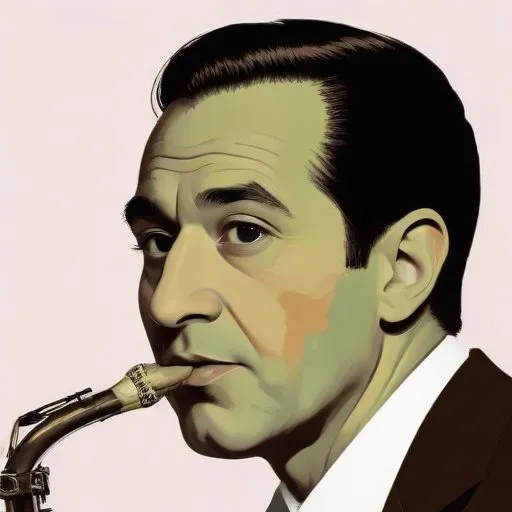
A renowned bassist, composer, and conductor who led the Boston Symphony Orchestra for 25 years, introducing many American premieres of works by prominent composers. He was a champion of modern classical music.
Serge Koussevitzky was a Russian-born conductor, composer, and double bassist who left an indelible mark on the world of classical music. As the music director of the Boston Symphony Orchestra from 1924 to 1949, Koussevitzky's tenure was marked by innovation, passion, and a commitment to nurturing new talent.
Born into a Jewish family of musicians in Vyshny Volochyok, Russia, Koussevitzky was surrounded by music from a young age. His parents taught him violin, cello, and piano, and he later learned trumpet. At 14, he received a scholarship to the Musico-Dramatic Institute of the Moscow Philharmonic Society, where he studied double bass with Rambusek and music theory.
Koussevitzky's talents did not go unnoticed. He joined the Bolshoi Theatre orchestra at 20 and succeeded his teacher, Rambusek, as the principal bassist in 1901. His debut as a soloist in Moscow in 1896 was followed by critical acclaim in Berlin in 1903.
In 1905, Koussevitzky married Natalie Ushkova, the daughter of a wealthy tea merchant, and resigned from the Bolshoi. The couple moved to Berlin, where Koussevitzky studied conducting under Arthur Nikisch, using his wife's wealth to pay off his teacher's gambling debts. This period marked the beginning of his conductor's career, and he soon became known for his innovative approaches to music.
In 1924, Koussevitzky became the music director of the Boston Symphony Orchestra, a position he held for 25 years. During his tenure, he introduced American audiences to works by modern composers such as Stravinsky, Shostakovich, and Bartok. He also commissioned works from prominent composers, including Ravel's "Bolero" and Gershwin's "Concerto in F."
Koussevitzky's impact on classical music was profound. He nurtured the careers of renowned conductors such as Leonard Bernstein and Charles Munch, and his advocacy for modern music helped shape the course of classical music in the 20th century.
Koussevitzky was a fierce advocate for modern music and believed that classical music should be accessible to all. He was known for his tireless efforts to promote new talent and introduce American audiences to unfamiliar repertoire.
Koussevitzky's life and career spanned a tumultuous period in world history, from the Russian Revolution to World War II. Despite the challenges, he remained committed to his art, leaving behind a legacy that continues to inspire and influence conductors and musicians around the world.
As a conductor, composer, and double bassist, Serge Koussevitzky left an indelible mark on the world of classical music. His innovative spirit, passion for modern music, and commitment to nurturing new talent continue to inspire generations of musicians and music lovers alike.
Born in 1918
A renowned musician who blended jazz, classical, and Broadway styles, creating iconic works like West Side Story, and inspiring generations with his charismatic performances and innovative compositions.
Born in 1873
A renowned Russian musician who composed iconic symphonies and piano concertos, and was also a skilled pianist and conductor, leaving a lasting legacy in classical music.
Born in 1882
A Russian master of music, renowned for revolutionizing classical music with bold, avant-garde compositions that blended traditional and modern elements. His iconic works, such as "The Rite of Spring," continue to inspire and influence artists across genres.
Born in 1881
A Hungarian musical genius who merged folk melodies with modernist techniques, creating a unique sound that transformed classical music.
Born in 1906
A renowned Russian pianist and composer, known for blending classical music with dark humor and satire, creating iconic symphonies and film scores that still resonate today.
Born in 1898
A renowned pianist and composer who blended jazz and classical music to create iconic works like "Rhapsody in Blue" and "An American in Paris", leaving a lasting impact on American music.
Born in 1875
A renowned viola player and conductor, he was a leading figure in the development of modern orchestral performance, particularly in the interpretation of French and Russian music.
Born in 1899
A renowned violinist and conductor, leading the Philadelphia Orchestra for over 40 years, known for his technical precision and interpretations of Romantic-era composers.
