


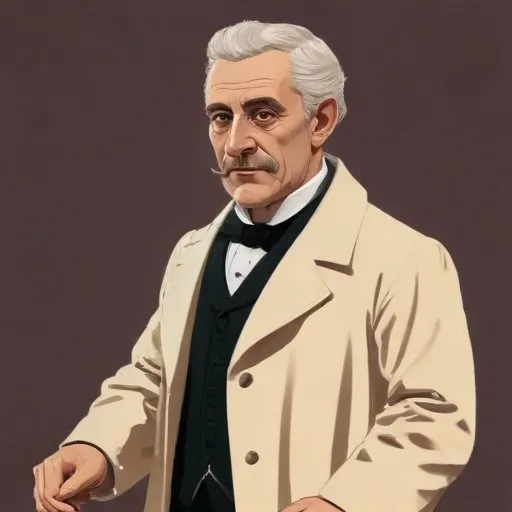
A French physician, botanist, and physiologist who discovered the process of osmosis and made significant contributions to the field of plant physiology. His work laid the foundation for modern understanding of plant biology.
Henri Dutrochet, a French physician, botanist, and physiologist, is renowned for his groundbreaking research on osmosis, a phenomenon that revolutionized our understanding of cellular biology. His work laid the foundation for modern biology, earning him recognition as one of the most influential scientists of the 19th century.
Born on November 14, 1776, in Nons, France, Dutrochet came from a noble family that was ruined during the French Revolution. He began his career in the military marine at Rochefort in 1799, but soon left to join the Vendean army. After leaving the army, he tended to his family's manor in Touraine, where he developed a passion for science.
Dutrochet's research spanned a wide range of topics, including embryology, respiration, and the effects of light on plants. However, his most significant contribution was the discovery of osmosis, a process by which water molecules move through a semipermeable membrane from an area of high concentration to an area of low concentration.
Dutrochet's work on osmosis revealed the crucial role of cell membranes in regulating the movement of molecules. He demonstrated that cells are the fundamental units of life, and his research paved the way for future discoveries in cellular biology.
Dutrochet's findings also had significant implications for our understanding of plant growth and development. He showed that plants respond to environmental stimuli, such as light, and that this responses are mediated through cellular processes.
Dutrochet's contributions to science have had a lasting impact on our understanding of biology and medicine. His work laid the foundation for modern cellular biology, and his discovery of osmosis has been recognized as a fundamental principle of biology.
The Mauritian plant genus Trochetia was named in his honor, a testament to the significance of his scientific contributions.
Dutrochet faced personal hardships, including the loss of his family's fortune and his own struggles with illness. Despite these challenges, he remained dedicated to his research and made significant contributions to science.
In recognition of his achievements, Dutrochet was appointed chief physician to the hospital at Burgos, Spain, and later devoted himself to the study of natural sciences in France.
Henri Dutrochet's pioneering work in osmosis and cellular biology continues to inspire scientists today, solidifying his place as one of the most influential scientists of the 19th century.
Born in 1744
A French soldier, biologist, and academic who developed a theory of inheritance of acquired characteristics, proposing that organisms adapt to their environment and pass on those traits to their offspring.
Born in 1769
Founded the field of comparative anatomy, establishing extinction as a fact and creating a framework for understanding the natural world through fossil records.
Born in 1775
A pioneer in the field of electromagnetism, he formulated fundamental laws that describe the relationship between electric currents and magnetic fields. His work laid the foundation for many modern technologies, including electric motors and generators.
Born in 1786
A mathematician and politician who made significant contributions to the development of electromagnetism and served as Prime Minister of France, advocating for social reform and education.
Born in 1749
Developed nebular hypothesis of the origin of the solar system and formulated Laplace's equation, a fundamental concept in mathematics and physics. He's considered the founder of celestial mechanics.
Born in 1743
Father of modern chemistry, discovered oxygen, and developed a systematic method of chemical nomenclature. He laid the foundation for modern chemistry and paved the way for future scientific discoveries.
Born in 1707
Developed the system of binomial nomenclature, which is still used today to classify and name living organisms. This system has had a profound impact on the fields of biology, ecology, and conservation.
Born in 1769
A pioneering geographer and explorer who mapped much of South America and discovered the Caspian Sea's connection to the Black Sea, greatly advancing our understanding of the natural world.
