


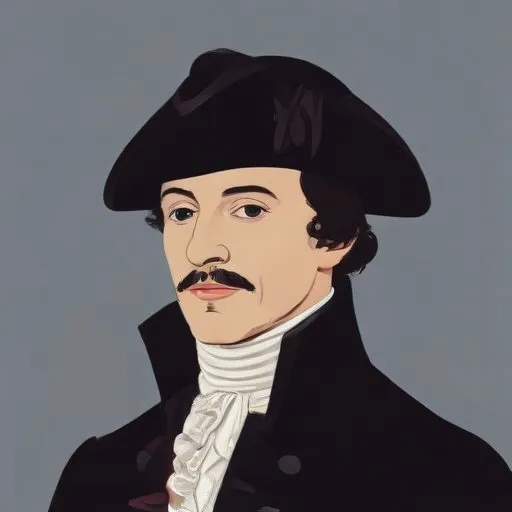
A French nobleman and historian who wrote influential works on French history and politics, challenging traditional views and promoting a more nuanced understanding of the past.
Henri de Boulainvilliers, a French nobleman, writer, and historian, is primarily remembered for his groundbreaking work on the origins of French nobility and the Third Estate, which had a profound impact on the understanding of French history and identity. His theory, which posited that the French nobility was of Germanic origin while the Third Estate was of Celtic origin, inspired generations of historians and thinkers, including Arthur de Gobineau.
Born on October 21, 1658, in Saint-Saire, Normandy, Henri de Boulainvilliers hailed from the House of Cro, tracing his lineage to Jean de Cro, sire de Clery et de Boulainviller, who died in the Battle of Poitiers in 1356. Despite the family's noble roots, their fortunes had declined significantly by the time of Henri's birth.
In 1669, Henri enrolled at the prestigious Collège de Juilly, where he received a rigorous education in exact sciences, history, and geography. The institution, founded by the Congregation of the Oratory of Philip Neri, was known for its emphasis on critical thinking and intellectual curiosity. Under the guidance of renowned educators like Malebranche and Richard Simon, Henri developed a strong foundation in Cartesian philosophy and critical history.
Boulainvilliers' historical work and political life centered on the decline of the nobility, which he attributed to the erosion of their traditional power and influence. He believed that the nobility had become detached from their Germanic roots and had adopted Celtic customs, leading to their decline. This theory, though contentious, sparked a lively debate among historians and thinkers of his time.
Boulainvilliers' contributions extended beyond history to various fields, including philosophy, theology, and astrology. He published an early French translation of Spinoza's Ethics, demonstrating his interest in exploring diverse intellectual traditions. His writing also touched on physics, reflecting his fascination with the natural world and the secrets it held.
Boulainvilliers' ideas had far-reaching consequences, shaping the understanding of French identity and the role of the nobility in society. His theories influenced the works of Arthur de Gobineau, who built upon his ideas to develop the concept of racial hierarchy. Though both thinkers have been criticized for their racialist views, their contributions to the development of modern historiography and sociology are undeniable.
Today, Henri de Boulainvilliers is remembered as a pioneer in the field of French history, whose work laid the groundwork for future generations of historians and scholars. His commitment to critical inquiry and intellectual curiosity continues to inspire researchers and thinkers, ensuring his legacy as a champion of knowledge and understanding.
Born in 1710
The monarch who ruled France from 1715 to 1774, known as the "Sun King's" great-grandson, and remembered for his extravagance, absolutism, and the decline of the French monarchy.
Born in 1619
A 17th-century mastermind who centralized France's economy, creating a powerful and efficient financial system that fueled the country's growth and prosperity. He's renowned for his innovative economic policies and reforms.
