


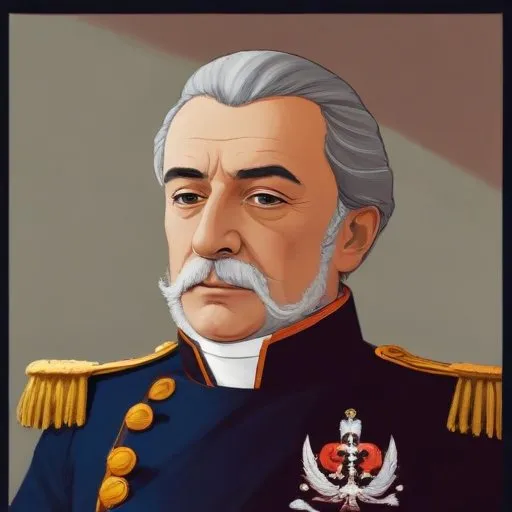
A French naval hero who served as Minister of War, known for his bravery in the Greek War of Independence and his role in the July Monarchy. He played a key part in shaping French military strategy during a tumultuous period in European history.
Henri de Rigny, also known as Marie Henri Daniel Gauthier, comte de Rigny, was a revered French naval officer who etched his name in history as the commander of the French squadron at the pivotal Battle of Navarino during the Greek War of Independence. This remarkable feat, which took place on October 20, 1827, showcased his exceptional military prowess and cemented his status as a prominent figure in French naval history.
Born on February 2, 1782, Henri de Rigny was the son of a former captain in the Penthivre Dragoon regiment. Following the French Revolution, his family's life was forever altered. His father's passing left his mother struggling to provide for their five young children, including Henri, who was just ten years old at the time.
In 1798, Henri de Rigny entered the navy as a midshipman under the guidance of Admiral Étienne Eustache Bruix. He swiftly proved himself to be an able and dedicated officer, participating in several significant naval campaigns, including the blockade of Porto Ferrajo, the Battle of Algeciras, and the Egyptian campaign. His valor and expertise earned him the rank of ensign in 1803.
In 1806, Henri de Rigny was embedded with the marines of the Guard in the Army, where he played a vital role in various land campaigns. He fought bravely in the Prussian, Polish, and Pomeranian campaigns, distinguishing himself at the Battle of Jena and the siege of Stralsund. His courage and tenacity led to his appointment as aide-de-camp to Marshal Bessières in 1808, during which he further demonstrated his mettle at the Battle of Medina de Rioseco and the Battle of Somosierra.
The Battle of Navarino, which took place on October 20, 1827, marked a pivotal moment in Henri de Rigny's career. As commander of the French squadron, he played a crucial role in the decisive victory over the Ottoman Empire, thus contributing significantly to the ultimate triumph of the Greek War of Independence. This battle showcased his exceptional tactical prowess and cemented his reputation as a master naval strategist.
Henri de Rigny's remarkable naval career was punctuated by numerous honors and awards. He was appointed Vice-Admiral in 1829 and eventually rose to the rank of Admiral in 1834. His illustrious career came to an end on November 6, 1835, when he passed away, leaving behind a legacy that continues to inspire generations of naval officers and historians alike.
Henri de Rigny's remarkable life and achievements serve as a testament to his unwavering dedication, bravery, and exceptional leadership. As a true trailblazer in the annals of French naval history, his legacy continues to inspire and educate generations to come.
Born in 1811
A French general who led the Army of the Rhine during the Franco-Prussian War, ultimately surrendering at Metz, marking a decisive turning point in the conflict. He's infamous for his defeat and subsequent court-martial.
Born in 1838
A French lawyer and politician who served as Prime Minister of France, known for his key role in the Franco-Prussian War and his efforts to modernize and unify France. He's a significant figure in French history, shaping the country's politics and identity.
Born in 1825
French statesman who served as Prime Minister of France from 1870 to 1873, known for his role in the Franco-Prussian War and the fall of the Second French Empire.
Born in 1828
A French lawyer and politician who served as Prime Minister of France, known for his role in the country's Third Republic and his efforts to reform the French government. He's also remembered for his strong stance against the authoritarian General Georges Boulanger.
Born in 1847
A short-lived president who served from 1894 to 1895 and is often overlooked in French history, known for his brief and uneventful term.
