


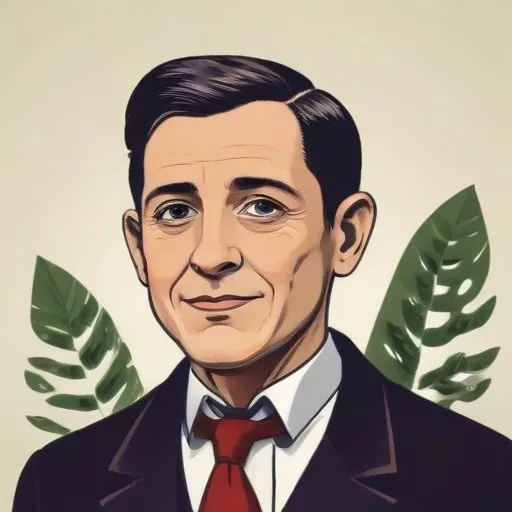
A British botanist and author who traveled extensively to collect and study plant specimens, particularly in the Caribbean, and wrote about his findings in several books. His work contributed significantly to the field of botany and our understanding of tropical plant species.
Henry Brougham Guppy, a British surgeon, geologist, botanist, and photographer, left an indelible mark on the scientific community with his groundbreaking research in the Pacific Islands. His extensive travels and meticulous documentation of the region's geology, botany, and marine life earned him the prestigious Linnean Medal in 1917.
Guppy was born on December 23, 1854, in Falmouth, England, to Dr. Thomas Stokes Guppy, a local physician, and his wife Charlott Ann Brougham. He received his education at Sherborne and later studied medicine at Queen's College in Birmingham and Edinburgh University, graduating with an MB CM degree.
Guppy's career as a surgeon in the Royal Navy (1876-1885) took him to the South China Seas and the western Pacific, where he served on board HMS Hornet and HMS Lark. During his time on shore in Korea in 1878, he began to develop an interest in geology and botany, laying the foundation for his future research.
In 1896, Guppy embarked on an extensive research expedition to the Pacific, studying coral reefs at the Keeling Islands, and conducting research in Java, Hawaii, and Fiji. His work continued until 1899, after which he returned to Britain to analyze his findings and write about them. From 1906 to 1914, he focused on the West Indies and the Azores, resuming his Pacific adventures in 1919.
Guppy was elected a Fellow of the Royal Society of Edinburgh in 1888 and a Fellow of the Royal Society of London in 1918. His contributions to science were recognized with the Linnean Medal in 1917.
Two species of reptiles, the gecko Lepidodactylus guppyi and the snake Uropeltis broughami, were named in his honor, commemorating his significant contributions to the fields of geology and botany.
Guppy married twice, first to Mary Annie Jordan in 1887 and then to Letitia Warde of Yalding in Kent in 1900.
Guppy passed away on April 23, 1926, en route from Tahiti to Britain, while on board the SS El Kantara, which was moored at Martinique. His remarkable legacy continues to inspire future generations of scientists and explorers.
Throughout his life, Henry B. Guppy exemplified the spirit of adventure, curiosity, and dedication to scientific discovery, leaving behind a rich legacy that continues to enrich our understanding of the Pacific Islands and their natural wonders.
Born in 1809
Developed the theory of evolution through natural selection, revolutionizing our understanding of life on Earth. This groundbreaking idea transformed the fields of biology, ecology, and beyond.
Born in 1817
A renowned botanist and explorer who contributed significantly to the discovery and classification of numerous plant species, particularly in the Himalayas and Antarctica. His work laid the foundation for modern botanical research.
Born in 1810
A pioneering botanist who contributed significantly to the development of American botany, particularly in the fields of plant classification and evolution.
Born in 1796
A British botanist and geologist who taught Charles Darwin at Cambridge University and inspired his love of natural history, leading to Darwin's voyage on the HMS Beagle. He was a pioneer in the field of botany, particularly in the study of algae.
Born in 1823
A pioneering naturalist who discovered evolution through natural selection, independently of Charles Darwin, and contributed significantly to the field of biogeography.
