


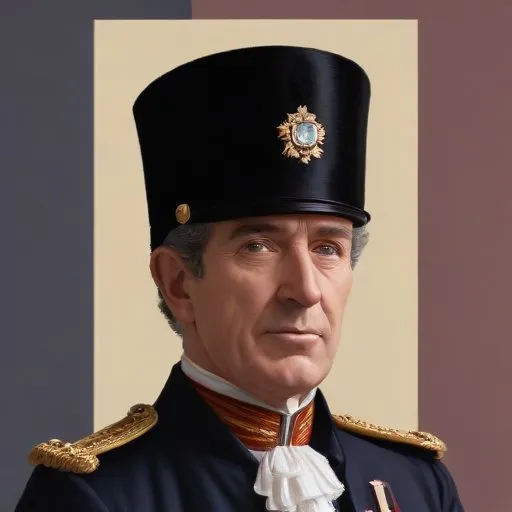
A prominent military leader and politician, he played a crucial role in the Battle of Waterloo and later served as Lord Lieutenant of Ireland, shaping the country's politics and governance.
Henry Paget, 1st Marquess of Anglesey, is renowned for his exceptional military prowess, particularly during the Napoleonic Wars, and his distinguished political career. As a decorated British Army officer, he commanded the cavalry in several pivotal battles, earning recognition for his bravery and tactical genius.
Born on May 17, 1768, Henry Bayley Paget was the eldest son of Henry Bayley-Paget, 1st Earl of Uxbridge, and Jane, daughter of the Very Reverend Arthur Champagné, Dean of Clonmacnoise, Ireland. He adopted the surname Paget in 1770. Paget received his education at Westminster School and later at Christ Church, Oxford.
Paget's entry into politics began in 1790 when he was elected as a member of parliament for Carnarvon, a seat he held until 1796. He then represented Milborne Port from 1796 to 1804 and again from 1806 to January 1810. During this period, he was appointed as Steward of the Chiltern Hundreds, resigning his seat temporarily.
At the outbreak of the French Revolutionary Wars, Paget raised a regiment of Staffordshire volunteers, earning the temporary rank of lieutenant-colonel-commandant in December 1793. As the 80th Regiment of Foot, the unit participated in the Flanders Campaign of 1794 under Paget's command. He demonstrated exceptional leadership skills, leading his cavalry to distinct superiority over their French counterparts in the Battle of Sahagún and the Battle of Benavente, where he defeated the elite chasseurs of the French Imperial Guard.
During the Hundred Days, Paget led the charge of the heavy cavalry against Comte d'Erlon's column at the Battle of Waterloo, where he suffered a severe injury, losing part of one leg to a cannonball. This courageous act earned him further recognition and respect from his peers and contemporaries.
In later life, Paget served twice as Master-General of the Ordnance and twice as Lord Lieutenant of Ireland. He continued to hold various positions of prominence, solidifying his reputation as a dedicated public servant and military strategist. Paget's remarkable life came to an end on April 29, 1854, leaving behind a legacy of bravery, tactical genius, and dedication to his country.
Henry Paget, 1st Marquess of Anglesey, serves as an inspiration to individuals seeking to make a meaningful impact in their chosen fields. His unwavering dedication, courage, and tactical brilliance in the face of adversity have left an indelible mark on history. As a testament to his remarkable life, Paget's legacy continues to motivate and inspire generations to strive for excellence and selfless service to their nation.
Born in 1762
The extravagant and flamboyant King of the United Kingdom, known for his lavish lifestyle, extravagant fashion sense, and architectural projects, including the transformation of Buckingham Palace. He played a significant role in the development of Regency London.
Born in 1759
Prime Minister of the United Kingdom from 1783 to 1801 and 1804 to 1806, known for leading the country through the French Revolutionary and Napoleonic Wars.
Born in 1762
The only British Prime Minister to be assassinated, he served from 1809 to 1812 and is known for his strong leadership during the Napoleonic Wars.
