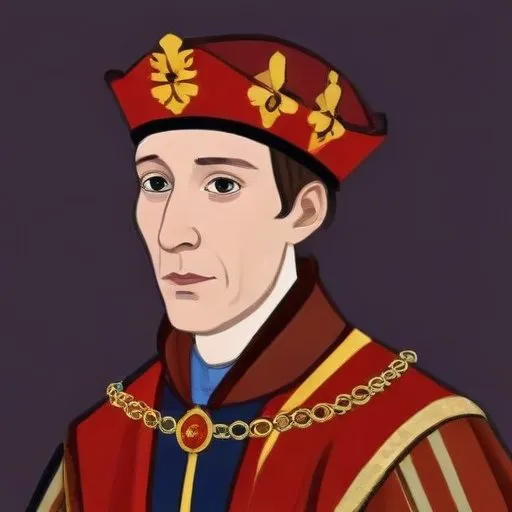
Henry VI: The Burgrave of Meissen and Lord of Plauen
A Life of Feudal Power and Conflict
Henry VI, the Burgrave of Meissen, Lord of Plauen, and Lord of Schleiz and Lobenstein, is best known for his tumultuous life amidst the complex web of feudal powers in 16th-century Europe. As a member of the House of Plauen, Henry VI was embroiled in a lifelong struggle to maintain his family's territories and influence, often pitted against the powerful Princely House of Reuss.
Early Life and Inheritance
Born on December 29, 1536, Henry VI was the younger of two sons of Henry IV, Burgrave of Plauen, and Countess Margaret of Salm. After his father's death, Henry VI and his older brother, Henry V, jointly ruled their extensive possessions, inheriting a dispute with the Reuss family that would shape their lives.
A Life of Conflict and Debt
The brothers' minority led to King Ferdinand of Bohemia's promise to protect them against the Reuss family. However, this came at a cost, as they incurred significant debt due to the court case. The brothers lost the districts of Hof and Schauenstein by imperial arbitration in 1556, and further debt led them to pledge the Lordships of Plauen and Oelsnitz and the district of Schneck to Elector August of Saxony in 1559.
Imperial Rulings and Treaty
On September 28, 1560, the imperial court in Vienna ruled against the brothers, forcing them to relinquish the Lordship of Greiz to the Reuss family on January 1, 1561, and half each of the Lordships of Gera and Schleiz. However, the dispute with the Reuss family eventually reached a conclusion with a treaty confirmed and sealed by the Emperor in Prague on March 9, 1562.
Division of Lands and Marriage
In 1563, the brothers decided to divide their lands, with Henry VI receiving the Lordships of Schleiz and Lobenstein and the district of Pausa. Henry VI married on April 9, 1564, at Fallersleben, but his financial troubles continued, leading to accusations that he had spent the money meant for repayments. As a result, the heartland of Plauen, the Lordships of Plauen and Oelsnitz, and the district Schneck were forever lost to Saxony.
Legacy and Historical Context
Henry VI's life is a testament to the complexities of feudal Europe, where power struggles and debt often defined the lives of nobility. His story serves as a reminder of the intricate web of alliances, rivalries, and imperial influences that shaped the continent during this period. Despite his tumultuous life, Henry VI remains an important figure in the history of the House of Plauen and the region of Meissen.
Key Dates and Events
- December 29, 1536: Born in Meissen
- 1556: Lost districts of Hof and Schauenstein by imperial arbitration
- 1559: Pledged Lordships of Plauen and Oelsnitz and district of Schneck to Elector August of Saxony
- September 28, 1560: Imperial court in Vienna ruled against the brothers
- January 1, 1561: Relinquished Lordship of Greiz to the Reuss family
- March 9, 1562: Treaty confirmed and sealed by the Emperor in Prague
- 1563: Divided lands with brother Henry V
- April 9, 1564: Married at Fallersleben
- January 22, 1572: Died in Schleiz
Trivia and Fun Facts
- Henry VI was the Burgrave of Meissen, a title equivalent to a Count or Earl.
- The House of Plauen was a powerful noble family in Eastern Europe during the Middle Ages.
- Henry VI's story highlights the often-overlooked complex relationships between nobility and imperial powers during the 16th century.
FAQ
What was Henry VIs role in German history?
Henry VI was a German nobleman who lived in the 13th century. He was a member of the House of Württemberg and played a significant role in the regions politics and economy.
What were Henry VIs achievements?
Henry VI was known for his military campaigns and expansion of Württembergs territories. He also founded several towns and cities, including Stuttgart, and established trade relationships with other regions.
How did Henry VI die?
Henry VI died in 1367, possibly due to injuries sustained in battle or illness. He was succeeded by his son, Eberhard II.
What is Henry VIs legacy?
Henry VIs legacy is that of a shrewd politician and military leader who expanded Württembergs territories and established its economy. He is remembered as one of the most important figures in the regions history.
Are there any notable artifacts or landmarks associated with Henry VI?
Yes, Henry VI is associated with the Stuttgart Castle, which he built in the 14th century. The castle is now a UNESCO World Heritage Site and a popular tourist destination.