


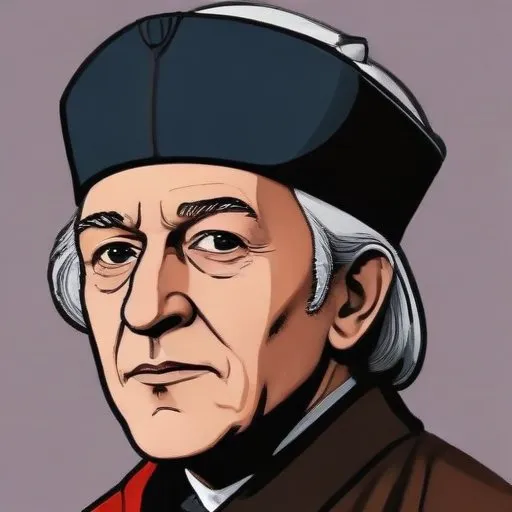
A prominent English politician who served as Chancellor of the Exchequer and Treasurer of the Household, known for his strong advocacy of parliamentary rights and liberties.
Sir Henry Vane the Elder was an English politician who left an indelible mark on the country's tumultuous history, serving in various capacities, including as Secretary of State, during the reign of King Charles I. He is perhaps best known for his pivotal role in the English Civil War, where he defected from the royalist cause to join the Parliamentarian forces, earning him a place among the most influential figures of the 17th century.
Vane was born on February 18, 1589, to Henry Vane of Hadlow, Kent, and his second wife, Margaret Twysden. He matriculated at Brasenose College, Oxford, in 1604 and later became a student at Gray's Inn in 1606. His connections and abilities earned him a knighthood from James I in 1611.
Vane's political career began to take shape when he married Frances Darcy, daughter of Thomas Darcy of Tolleshunt D'Arcy, Essex, in 1612. He then utilized his connections to secure a carver's place at court, followed by the purchase of a third part of the subpoena office in chancery. His astute political maneuvering earned him the reversion of the whole office for forty years from King James.
Subsequent appointments included Comptroller of the Household (1629) and Treasurer of the Household (1639). Vane's close relationships with prominent figures, such as the Duke of Buckingham and Lord Weston, further solidified his position within the royal court.
Vane's parliamentary career spanned multiple terms, with his first election as Member of Parliament for Lostwithiel in 1614. He continued to serve in various capacities, including as Secretary of State, until the outbreak of the English Civil War in 1642.
Vane's decision to defect from the royalist cause to the Parliamentarian forces had significant implications for the war's outcome. His influence and experience proved invaluable to the Parliamentarian party, contributing to their ultimate victory.
Sir Henry Vane the Elder's legacy is complex, marked by both controversy and admiration. While his political agility and service to the crown are undeniable, his decision to defect and subsequent role in the English Civil War continue to spark debate among historians.
Sir Henry Vane the Elder's life and career are inextricably linked with the tumultuous era in which he lived. His experiences and decisions continue to provide valuable insights into the complexities of 17th-century English politics and the English Civil War.
As a historian, Vane's life serves as a testament to the often-blurred lines between personal ambition, political loyalty, and national interests. His legacy remains an essential part of England's storied past, offering a unique window into the country's most turbulent period.
Born in 1599
Leader of the Parliamentarian forces during the English Civil War, who later ruled England, Scotland, and Ireland as a republican dictator, known for his military victories and radical reforms.
Born in 1676
The first Prime Minister of the United Kingdom, serving from 1721 to 1742, known for establishing the office of Prime Minister and setting important precedents for the role. He is also recognized for his skill in managing Parliament and his role in shaping British politics.
Born in 1623
A 17th-century republican thinker who advocated for individual liberties and constitutional government, influencing the development of modern democratic thought.
