


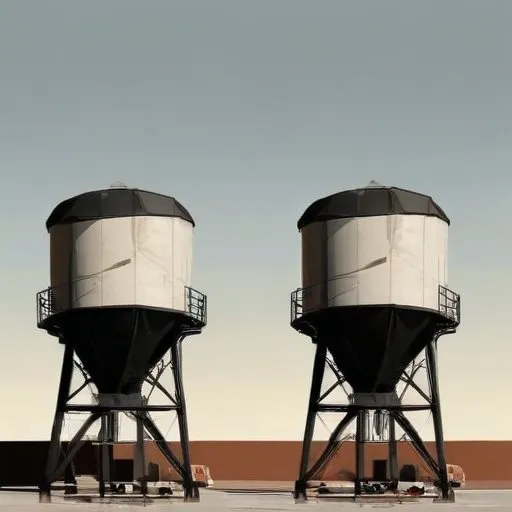
Pioneering conceptual photographer capturing industrial structures in a detached, typological style, revealing the beauty in functional architecture.
Hilla Becher, a renowned German conceptual photographer, is celebrated for her distinctive typologies and industrial landscapes, often captured in collaboration with her husband, Bernd Becher. Her work, spanning over five decades, has left an indelible mark on the world of photography, earning her numerous accolades, including the prestigious Erasmus Prize and the Hasselblad Award.
Born on September 2, 1934, in Potsdam, East Germany, Becher was exposed to the world of photography from a young age. Her mother, a photography enthusiast, occasionally worked in a studio, retouching photographs, and her father, a high school language teacher, later drafted to World War II. This familial influence sparked Becher's interest in photography, which she began practicing at the age of 13 with a 9x12 cm plate camera.
In 1951, Becher became an intern for Walter Eichgrun, a working studio and commissioned photographer, while studying photography at a vocational school and finishing her high school degree in Berlin. She spent three years working on commission with Eichgrun and completed various solo assignments. In 1954, she and her mother moved to West Germany, where she worked as a freelance photographer in Hamburg.
In 1957, Becher was offered a job in Düsseldorf, Germany as an advertising photographer, and around 1958, she enrolled at the Kunstakademie Düsseldorf under Walter Breker, studying graphic design and printing techniques. She was the first student to be admitted to the class based on a portfolio consisting solely of photographs.
It was during her time at the Kunstakademie that Becher met her future husband and collaborator, Bernd Becher. Together, they developed a unique style of photography, focusing on industrial buildings, water towers, and other structures, which they presented in a grid-like formation, known as typologies. This distinctive approach allowed them to highlight the similarities and differences between these industrial structures.
Their collaboration led to the creation of the Düsseldorf School of Photography in the mid-1970s, which became a hub for influential photographers, including Candida Höfer, Thomas Ruff, and Thomas Struth.
Throughout her illustrious career, Becher received numerous honors and accolades, solidifying her position as a pioneer in the world of photography.
Hilla Becher's contributions to photography have had a profound impact on modern society, inspiring generations of photographers and artists. Her work has not only influenced the way we perceive industrial landscapes but has also contributed to the development of conceptual photography.
Becher's legacy continues to inspire and educate, with her photographs serving as a testament to her innovative approach and dedication to the art of photography.
Hilla Becher passed away on October 10, 2015, at the age of 81, in Düsseldorf. Her remarkable life and career serve as a testament to her passion and dedication to photography.
Born in 1865
Pioneering photographer capturing intricate, artistic portraits of plants and flowers, showcasing their architectural forms and beauty.
Born in 1895
Documented the lives of those affected by the Great Depression and the Dust Bowl through powerful, poignant photographs that humanized the struggles of the era. Captured iconic images that shaped the national conversation around poverty and social justice.
Born in 1903
Documenting everyday American life through poignant and influential photographs, capturing the essence of the Great Depression and post-war era.
Born in 1924
A pioneer of street photography, capturing candid, unglamorized images of American life, and directing films that explore the human condition.
98 Years Old
A pioneer of street photography, capturing candid, unposed moments of everyday life in post-war America, revealing the beauty in the mundane.
