


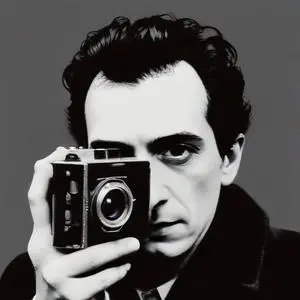
A pioneer of street photography, capturing candid, unglamorized images of American life, and directing films that explore the human condition.
Robert Frank, the Swiss-American photographer and documentary filmmaker, is perhaps best known for his groundbreaking book, The Americans, which shattered conventions and redefined the way we perceive American society. Published in 1958, this iconic work is often regarded as the most influential photography book of the 20th century, with critic Sean O'Hagan praising it for "chang[ing] the nature of photography, what it could say and how it could say it."
Born on November 9, 1924, in Zurich, Switzerland, Frank grew up in a Jewish family with a complex nationality situation. His mother, Rosa, held a Swiss passport, while his father, Hermann, had become stateless after losing his German citizenship due to the Nazi regime. This tumultuous backdrop influenced Frank's understanding of oppression and fueled his passion for photography as a means to escape his business-oriented family and home.
Frank trained under various photographers and graphic designers before creating his first handmade book of photographs, 40 Fotos, in 1946. He later emigrated to the United States in 1947, securing a job as a fashion photographer for Harpers Bazaar in New York City.
The Americans, Frank's magnum opus, is a visceral and poignant portrayal of American society in the 1950s. This collection of 83 photographs, taken during a two-year road trip across the country, captures the essence of American life, from rural landscapes to urban streets, and from racial tensions to poverty. The book's raw, unflinching gaze sparked controversy and accolades alike, with many praising its innovative storytelling and visual language.
Frank's work extended beyond still photography, as he explored film and video, experimenting with manipulated photographs and photomontage. He collaborated with artists like Allen Ginsberg and Jack Kerouac, contributing to the development of Beat Generation iconography.
Some of Frank's notable works include:
Robert Frank's work has left an indelible mark on the world of photography and beyond. His innovative approach, which blurred the lines between documentary and art, has inspired generations of photographers, filmmakers, and artists. The Americans, in particular, has become a cultural touchstone, influencing everything from literature to music to fashion.
Frank's legacy extends beyond the art world, as his work has contributed to a deeper understanding of American identity, culture, and society. His photographs continue to provoke, inspire, and challenge viewers, ensuring his place as one of the most important and influential visual artists of the 20th century.
Throughout his career, Frank has received numerous accolades, including:
Robert Frank's remarkable body of work serves as a testament to his vision, creativity, and dedication to capturing the human experience. His influence will continue to reverberate, inspiring future generations of artists, photographers, and storytellers.
Born in 1922
Pioneering figure of the Beat Generation, known for spontaneous, confessional, and poetic writings that captured the essence of American counterculture in the 1950s and 60s.
Born in 1926
A leading figure of the Beat Generation, known for his poetry that explores themes of nonconformity, free expression, and social justice. His iconic poem "Howl" is a classic of American literature.
Born in 1914
A pioneering figure of the Beat Generation, known for experimental and provocative works that blended fiction and reality, pushing boundaries of literature and art.
96 Years Old
Beat poet of the 1950s and 60s, known for his spontaneous, conversational style and rebellious, nonconformist spirit. His poetry often explored themes of alienation, social disillusionment, and the search for authenticity.
96 Years Old
Pioneering independent filmmaker known for intense, emotionally charged dramas that explored the human condition, often using improvisation and a naturalistic style.
Born in 1903
Documenting everyday American life through poignant and influential photographs, capturing the essence of the Great Depression and post-war era.
Born in 1913
A pioneering photographer and cinematographer capturing poignant, intimate moments of urban life, particularly in New York City's working-class neighborhoods.
Born in 1895
Documented the lives of those affected by the Great Depression and the Dust Bowl through powerful, poignant photographs that humanized the struggles of the era. Captured iconic images that shaped the national conversation around poverty and social justice.
