


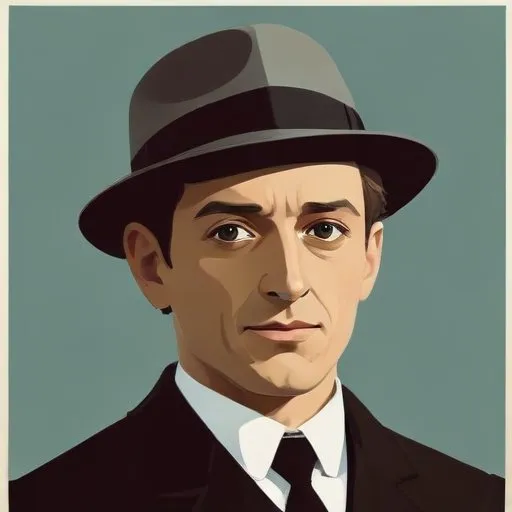
A German film and culture academic who championed cultural education and democratization of art, founding the Frankfurt Film Museum and promoting film as a cultural asset.
Hilmar Hoffmann, the renowned German stage and film director, cultural politician, and academic lecturer, is best known for founding the International Short Film Festival Oberhausen, as well as his instrumental role in transforming Frankfurt into a city of culture, rather than just commerce.
Through his tireless efforts, Hoffmann initiated the creation of the Museumsufer, a series of 15 new museums along the Main River, including the iconic Städel Museum and the Jewish Museum Frankfurt, which was the first independent Jewish museum in Germany.
Hoffmann was born on August 25, 1925, in Bremen, Germany, to an export merchant family. He attended gymnasium in Lüneburg and later in Oberhausen. During World War II, he served as a paratrooper and was a prisoner of war in the United States.
Upon his return to Germany in 1947, Hoffmann pursued his passion for directing at the Folkwang Hochschule for Music and Theater in Essen, graduating with a diploma in 1951.
Hoffmann's early career saw him work as an assistant stage director at the Theater Essen, followed by his appointment as director of the Volkshochschule adult education center in 1951, a position he held until 1965.
In 1954, he founded the International Short Film Festival Oberhausen, which he directed until 1970. This festival became a hub for avant-garde and experimental filmmaking, showcasing works by renowned directors such as Jean-Luc Godard and Martin Scorsese.
From 1965 to 1970, Hoffmann served as the Kultur und Sozialdezernent of Oberhausen, responsible for culture and social politics. During this period, he was also a lecturer at the Ruhr University in Bochum.
As a city councillor in Frankfurt from 1970 to 1990, Hoffmann championed the development of urban culture, initiating the promotion of free groups, street theatre, and establishing 30 libraries in suburban areas.
Hoffmann's vision for Frankfurt's cultural landscape culminated in the creation of the Museumsufer, a series of 15 museums along the Main River. This cultural complex transformed the city's riverbank into a vibrant hub of artistic expression and intellectual curiosity.
The Jewish Museum Frankfurt, which opened in 1988, was a crowning achievement of Hoffmann's vision, providing a platform for the preservation and celebration of Jewish history and culture.
Hoffmann received numerous awards for his contributions to culture and education, including the Goethe-Plakette of the City of Frankfurt and the Federal Cross of Merit.
Hoffmann's tireless dedication to cultural innovation and urban development has left an indelible mark on Frankfurt and beyond. His commitment to promoting artistic expression, preserving cultural heritage, and fostering intellectual curiosity continues to inspire generations of artists, educators, and civic leaders.
As a testament to his enduring legacy, the city of Frankfurt has named a street after him, commemorating his significant contributions to its cultural landscape.
Hoffmann's life's work was guided by his unwavering commitment to the concept of "Kultur für alle" (Culture for All), which emphasizes the importance of making art and culture accessible to people from all walks of life.
Through his writings, including his book "Kultur für alle," Hoffmann advocated for a more inclusive and democratic approach to cultural policy, encouraging communities to engage with art and culture as a means of promoting social cohesion and understanding.
Hoffmann's personal life was marked by significant milestones, including his marriage to Ursula Rößler in 1952, with whom he had three children.
In 2018, at the age of 92, Hoffmann passed away, leaving behind a rich cultural legacy that continues to inspire and enrich the lives of people around the world.
81 Years Old
A renowned filmmaker acclaimed for his poignant and visually stunning works that often explore the human condition, particularly in the context of identity, culture, and social change.
87 Years Old
German New Wave pioneer behind films like "The Tin Drum" and "Death of a Salesman", known for adapting literary classics into cinematic masterpieces.
81 Years Old
A prolific filmmaker who explored themes of social inequality, identity, and human relationships through his provocative and emotionally charged movies, leaving an indelible mark on New German Cinema.
93 Years Old
A pioneering filmmaker known for experimental, avant-garde works that challenge traditional narrative structures and explore the relationship between sound and image. His films often focus on the human condition, politics, and social issues.
82 Years Old
Experimental filmmaker and video artist who explores the relationship between image, politics, and ideology through critical and thought-provoking works.
