


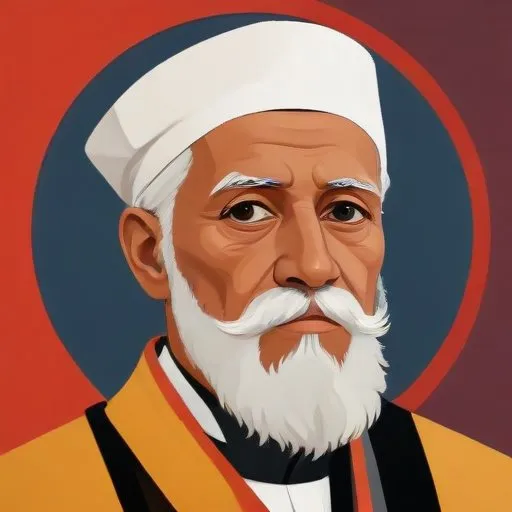
A 17th-century expert in Oriental languages and cultures, known for his groundbreaking studies on Ethiopian languages and scripts. He laid the foundation for modern Ethiopian studies.
Hiob Ludolf, a German orientalist, is renowned for his pioneering work in Ethiopian studies, earning him the title as the most illustrious name in Ethiopic scholarship. His groundbreaking research and publications on the Ethiopian language, history, and culture have had a lasting impact on the field, making him an authority in the discipline.
Born on June 15, 1624, in Erfurt, Germany, Ludolf's fascination with languages began at an early age. He pursued his passion by studying philology at the Erfurt academy and later at Leiden, where he honed his skills in linguistics.
In 1649, Ludolf traveled to Rome in search of documents for the Swedish Court, where he met Abba Gorgoryos, a monk from the Ethiopian province of Amhara. This chance encounter proved to be a pivotal moment in Ludolf's life, as he acquired an intimate knowledge of the Ethiopian language of Amhara from Abba Gorgoryos.
In 1652, Ludolf entered the service of the Duke of Saxe-Gotha, a position he held until 1678. During this period, he continued to nurture his linguistic skills, laying the foundation for his future contributions to Ethiopian studies.
In 1683, Ludolf ventured to England to promote a cherished scheme for establishing trade with Ethiopia. Although his efforts were met with resistance from the authorities of the Ethiopian Orthodox Church, his dedication to the cause never wavered.
Following his return to Frankfurt in 1684, Ludolf devoted himself wholeheartedly to literary work, producing a plethora of publications that would cement his legacy in Ethiopian studies.
Ludolf's exchange of letters with the renowned philosopher and mathematician Gottfried Wilhelm Leibniz on linguistics was published posthumously in 1755 by August Benedict Michaelis, showcasing his expertise in the field.
Ludolf's contributions to Ethiopian studies have had a lasting impact, with his dictionaries and grammars remaining indispensable tools for scholars for over a century and a half. His monumental history of Ethiopia continues to be a valuable resource for researchers, demonstrating the significance of his life's work.
Hiob Ludolf's dedication to the study of Ethiopian language, history, and culture has left an indelible mark on the field, earning him the title as the Father of Ethiopian Studies. His pioneering work continues to inspire and inform scholars, ensuring his legacy as a true giant in the discipline.
Born in 1646
Developed calculus independently of Isaac Newton, and made major contributions to the fields of philosophy, politics, and history.
Born in 1812
German astronomer who discovered Neptune in 1846, making a major breakthrough in planetary astronomy.
Born in 1719
A German mathematician and epigrammatist who made significant contributions to the field of mathematics, particularly in the areas of algebra and geometry, and was also known for his witty sayings and poems.
Born in 1707
Pioneering mathematician and physicist who made immense contributions to fields like calculus, number theory, and optics, shaping the course of modern mathematics and physics.
Born in 1679
Developed a philosophical system that combined elements of Leibniz and Descartes, and was a prominent figure in the German Enlightenment. He wrote extensively on metaphysics, ethics, and logic.
Born in 1717
A French Enlightenment thinker who made significant contributions to mathematics, physics, and philosophy, particularly in the fields of fluid dynamics and the study of vibrating strings. He's also known for his work on the Encyclopedia, a comprehensive reference work that aimed to compile all knowledge of the time.
Born in 1736
Developed calculus, number theory, and celestial mechanics, making significant contributions to the fields of mathematics and astronomy.
