


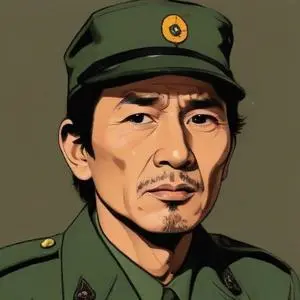
A Japanese Imperial Army intelligence officer who refused to surrender after World War II, holding out in the jungle for 29 years, believing the war was still ongoing. He finally surrendered in 1974, becoming an international sensation.
Hiroo Onoda, a second lieutenant in the Imperial Japanese Army, defied all odds by continuing to fight after the end of World War II, holding out for nearly 29 years on a remote island in the Philippines. His extraordinary story of resilience, determination, and unwavering loyalty is one that has captivated the world and earned him a place in history.
Born on March 19, 1922, in Kamekawa, Wakayama Prefecture, Japan, Onoda was conscripted into the Imperial Japanese Army in 1942. He trained as an intelligence officer at the Futamata branch of the army's Nakano School, where he was instructed in guerrilla warfare. In December 1944, he was sent to lead guerrilla warfare operations on Lubang Island in the Japanese-occupied Philippines.
Onoda's orders were clear: destroy the island's airstrip and pier, and destroy any enemy planes or boats that attempted to land. But there was a catch – he was explicitly instructed not to surrender to the enemy or take his own life, no matter the circumstances. This mandate would shape the course of his life for nearly three decades.
When Onoda arrived on Lubang, he joined forces with a group of Japanese soldiers who had been sent there previously. However, the officers in the group outranked him, preventing him from carrying out his assignment. As a result, the island fell to the United States and Philippine Commonwealth forces when they landed on February 28, 1945. One by one, his comrades either surrendered or were killed, leaving Onoda alone to continue the fight.
For 28 years, Onoda engaged in guerrilla warfare, living off the jungle and carrying out occasional attacks on locals and the police. He remained steadfast in his conviction, unaware that the war had ended and Japan had surrendered. His determination was unmatched, even when he found leaflets and newspapers announcing Japan's defeat – he believed it was a ruse to trick him into surrendering.
In 1974, a series of events finally led to Onoda's surrender. A search party was sent to the island, and on March 9, 1974, Onoda was contacted by a Japanese journalist, Norio Suzuki, who had been searching for him. Suzuki convinced Onoda to meet with his former commanding officer, Major Yoshimi Taniguchi, who was flown to the island to relieve Onoda of his duty. On March 10, 1974, Onoda finally surrendered, bringing an end to his remarkable holdout.
Onoda's story is a testament to the power of loyalty, duty, and determination. His hero's welcome in Japan was followed by a life of quiet reflection, during which he wrote a memoir, No Surrender: My Thirty-Year War, detailing his experiences on Lubang. He passed away on January 16, 2014, at the age of 91, leaving behind a legacy that continues to inspire and fascinate people around the world.
Born in 1885
A Japanese general who led the invasion of Malaya and the Philippines during World War II, known for his brutal tactics and war crimes. He was later tried and executed for his atrocities.
Born in 1887
A Japanese general who led the invasion of the Philippines during World War II and was later tried for war crimes, known for his role in the Bataan Death March.
