


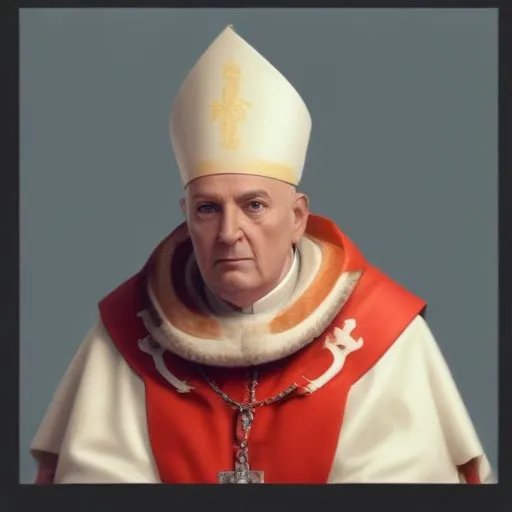
The Pope who played a key role in the Investiture Controversy, a major conflict between the Catholic Church and European monarchies over the power to appoint bishops and abbots. He's also known for his efforts to reform the Church and promote the Crusades.
Honorius II, born Lamberto Scannabecchi, was the Pope of the Catholic Church from 1124 to 1130, known for his relentless efforts to preserve the privileges granted to the Church through the Concordat of Worms and his support for new monastic orders.
Lamberto Scannabecchi was born in Fiagnano, near Imola, Italy, to a humble rural family. Despite his modest beginnings, his exceptional intellect and abilities propelled him through the ecclesiastical hierarchy. He became archdeacon of Bologna, where he caught the attention of Pope Urban II, who appointed him cardinal priest of an unknown church around 1099. Later, Pope Paschal II made him a Canon of the Lateran and eventually elevated him to a prominent position.
In 1124, Lamberto Scannabecchi was elected Pope, taking the name Honorius II. However, his election was contested by Celestine II, and force was used to guarantee his election. Throughout his pontificate, Honorius II focused on preserving and extending the privileges granted to the Church through the Concordat of Worms. He was the first pope to confirm the election of a Holy Roman Emperor.
Honorius II distrusted the traditional Benedictine order and instead favored new monastic orders, such as the Augustinians and the Cistercians. He sought to exercise more control over the larger monastic centers of Monte Cassino and Cluny Abbey. In 1128, he approved the new military order of the Knights Templar, which would go on to play a significant role in Christian history.
Despite his efforts, Honorius II failed to prevent Roger II of Sicily from extending his power in southern Italy and was unable to stop Louis VI of France from interfering in the affairs of the French Church. He managed the Church's affairs through Papal Legates, but his death in 1130 led to a period of confusion with the election of two rival popes, Innocent II and the antipope Anacletus II.
Honorius II's pantificate, although marked by challenges, left a lasting impact on the Church. His support for new monastic orders and the Knights Templar paved the way for future reforms and innovations. Although he faced setbacks, his commitment to preserving Church privileges and promoting monastic reform continues to influence the Catholic Church to this day.
Born in 1611
Led the Catholic Church during a tumultuous period, reforming the Church's finances and combating corruption, while also opposing the French monarch's attempts to exert control over the Church.
Born in 1599
A 17th-century pope who commissioned grand architectural projects, including the colonnade of St. Peter's Square, and was a patron of the arts.
Born in 1568
The 17th-century Catholic leader who reigned for 21 years, known for his strong stance against Galileo Galilei and his scientific discoveries, as well as his extensive patronage of the arts.
Born in 1502
Introduced the Gregorian calendar, a solar-based calendar that's widely used today, reforming the Julian calendar's inaccuracies.
