


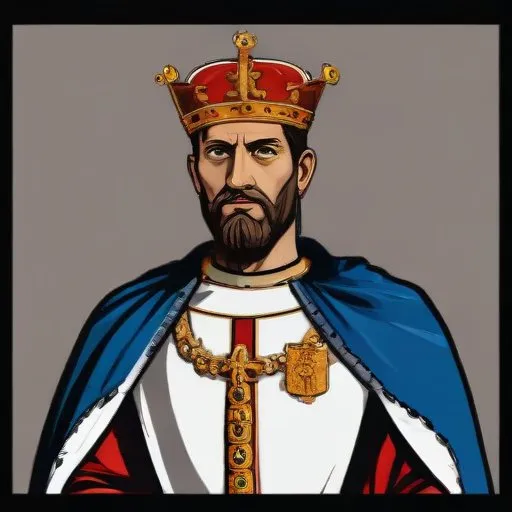
Unified Sicily and southern Italy under one rule, establishing a powerful kingdom that flourished culturally and economically. He's also known for his tolerant and enlightened policies towards Muslims and Jews.
Roger II of Sicily, also known as Roger the Great, is renowned for his remarkable reign as King of Sicily and Africa, leaving an indelible mark on the medieval world. He is celebrated for his military conquests, administrative reforms, and cultural achievements, earning him a place among the most prominent figures of the 12th century.
Born on December 22, 1095, in Mileto, Calabria, Roger was the youngest son of Roger I of Sicily and Adelaide del Vasto. Following the death of his brother Simon in 1105, Roger inherited the County of Sicily under the regency of his mother, Adelaide del Vasto. With the guidance of notable figures like Christodulus, the Greek emir of Palermo, Roger's mother oversaw his early reign.
Roger's military prowess and strategic alliances enabled him to expand his dominion significantly. In 1127, he became Duke of Apulia and Calabria, and in 1130, he was crowned King of Sicily. His most notable achievement came in 1148, when he conquered Africa, earning him the title of King of Africa. Roger's military campaigns were marked by his tolerance and respect for the diverse cultures and religions of the regions he conquered.
Roger II introduced several administrative reforms, centralizing power and establishing a strong, efficient government. He promoted the use of Arabic, Greek, and Latin in his court, fostering a culturally diverse and tolerant environment. The king was a patron of the arts and architecture, commissioning the construction of the magnificent Cattedrale di Cefalù and the Palazzo dei Normanni in Palermo.
Roger II married three times, first to Elvira of Castile, then to Sibylla of Burgundy, and finally to Beatrice of Rethel. He had several children, including Roger III, Duke of Apulia, and Conrad, Duke of Apulia and Calabria. Roger II's legacy extends beyond his military conquests and administrative reforms; he is remembered for his cultural achievements, tolerance, and promotion of diversity.
Roger II's reign coincided with the rise of other prominent medieval leaders, including Frederick I, Holy Roman Emperor, and Manuel I Komnenos, Byzantine Emperor. While these leaders engaged in conflicts and rivalries, Roger II maintained a unique position, balancing his relationships with the Byzantine Empire, the Holy Roman Empire, and the Muslim world.
Roger II of Sicily's remarkable achievements, tolerance, and cultural achievements have cemented his place as one of the most significant figures of the 12th century. His legacy continues to inspire and fascinate historians and scholars to this day.
Born in 1415
The last of the Habsburg emperors, he ruled the Holy Roman Empire from 1452 to 1493, known for his efforts to reform the empire and strengthen its central authority.
Born in 1086
Ruling the Holy Roman Empire from 1111 to 1125, he was a powerful monarch who clashed with the Catholic Church over investiture, sparking a major controversy. He's also known for his complex, often tumultuous relationships with nobles and bishops.
Born in 1194
Ruling the Holy Roman Empire from 1220 to 1250, he was a powerful and cultured leader who promoted arts, science, and architecture, and was known for his impressive constructions, including the Castel del Monte.
