


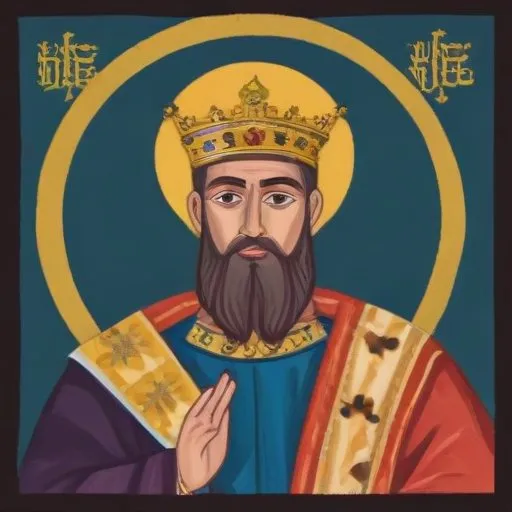
Byzantine emperor who ruled from 1143 to 1180, known for his military campaigns, cultural achievements, and diplomatic efforts to strengthen the empire.
Manuel I Komnenos, also known as Manuel Komnenos, was a Byzantine Emperor who reigned from 1143 to 1180, leaving an indelible mark on the history of Byzantium and the Mediterranean. He is renowned for his ambitious foreign policy, which witnessed the resurgence of military and economic power, as well as a cultural revival, earning him the nickname "Ho Megas" or "The Great".
Born on November 28, 1118, Manuel was the fourth son of John II Komnenos and Irene of Hungary. He ascended to the throne in 1143, following the death of his father, and his elder brothers' deaths in quick succession. Manuel's reign was marked by a series of decisive military campaigns, diplomatic alliances, and strategic marriages, which transformed the Byzantine Empire into a dominant force in the region.
Manuel's foreign policy was characterized by a desire to restore Byzantium's greatness, which had waned since the 11th century. He forged alliances with Pope Adrian IV and the resurgent West, attempting to reconquer territories lost to the Normans in Sicily and southern Italy. Although his campaigns in Sicily were unsuccessful, Manuel successfully managed the passage of the Second Crusade through his empire, establishing a Byzantine protectorate over the Crusader states of Outremer.
Manuel's reign witnessed a cultural renaissance, marked by a revival of classical Greek learning and the arts. He patronized scholars, writers, and artists, encouraging the translation of ancient texts and the creation of new works. The Byzantine Empire experienced a period of unprecedented prosperity, with Manuel's court becoming a center of learning and culture.
Despite the setbacks of his later years, including the disastrous Battle of Myriokephalon in 1176, Manuel's legacy as a great statesman and military leader has endured. His diplomatic prowess, military campaigns, and cultural achievements continue to inspire and fascinate historians and scholars today.
Manuel married twice, first to Bertha of Sulzbach and then to Maria of Antioch, with whom he had several children. His personal relationships were marked by a series of diplomatic marriages and alliances, which further solidified his position as a dominant force in the Mediterranean.
Manuel I Komnenos died on September 24, 1180, leaving behind a legacy that would shape the course of Byzantine history for centuries to come. His remarkable achievements, both on and off the battlefield, have earned him a lasting place in the annals of history as one of the greatest Byzantine emperors of all time.
Manuel's reign coincided with a period of significant change in the Mediterranean, marked by the rise of the Crusader states, the resurgence of the Seljuk Turks, and the decline of the Fatimid Caliphate. His diplomatic and military achievements, coupled with his cultural revival, cemented Byzantium's position as a major power in the region.
Manuel's legacy has had a lasting impact on modern society, influencing the development of Eastern Orthodox Christianity, the arts, and the politics of the region. His reign serves as a testament to the complexities and challenges of statecraft, diplomacy, and warfare in the medieval era.
Manuel's contemporaries, including the Crusader kings of Jerusalem and the Seljuk sultans, recognized his military prowess and diplomatic acumen. His achievements in the west, particularly in Sicily and Italy, rivaled those of his medieval counterparts, including the Norman kings of Sicily and the Holy Roman Emperors.
In conclusion, Manuel I Komnenos remains an enigmatic figure, whose remarkable achievements and visionary leadership have left an indelible mark on the history of Byzantium and the Mediterranean. His legacy continues to inspire and fascinate, offering a unique window into the complexities of medieval politics, warfare, and culture.
Born in 1087
Byzantine emperor who ruled from 1118 to 1143, known for his military campaigns and territorial expansions, strengthening the empire's borders and economy.
Born in 1093
Son of the Byzantine emperor Alexios I, he was a prince and a rebel who led a failed coup against his brother John II Komnenos, and later became a vassal of the Crusader Kingdom of Jerusalem. He is known for his tumultuous life and struggles for power.
Born in 1091
A Byzantine prince and general who led a rebellion against his uncle, Emperor Manuel I, and later became emperor himself, known for his brutal and violent reign. He's infamous for his cruelty, especially towards the aristocracy and the capital's population.
