


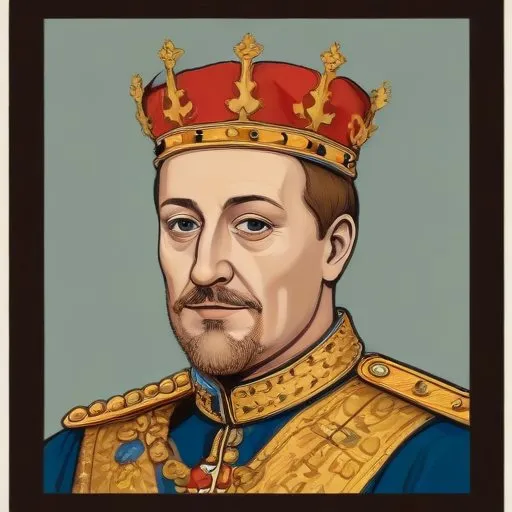
The last of the Habsburg emperors, he ruled the Holy Roman Empire from 1452 to 1493, known for his efforts to reform the empire and strengthen its central authority.
Frederick III, crowned Holy Roman Emperor in 1452, is renowned for his 53-year reign, the longest in the history of the Holy Roman Empire or the German monarchy. He is credited with laying the foundations for the later Habsburg Empire, reunifying the Habsburg hereditary lands of Austria, and securing a strong grip on the Austrian lands for his son Maximilian.
Born in 1415 at the Tyrolean residence of Innsbruck, Frederick was the eldest son of Ernest the Iron, a member of the Leopoldian line of the Habsburg dynasty, and his second wife Cymburgis of Masovia. According to the 1379 Treaty of Neuberg, the Leopoldinian branch ruled over the duchies of Styria, Carinthia, and Carniola, referred to as Inner Austria.
Frederick's path to imperial power began when he became duke of the Inner Austrian lands of Styria, Carinthia, and Carniola in 1424. He later acted as regent over the Duchy of Austria from 1439 and was elected and crowned King of Germany in 1440. In 1452, he was crowned Holy Roman Emperor by Pope Nicholas V, becoming the penultimate emperor to be crowned by the pope and the last to be crowned in Rome.
During his reign, Frederick concentrated on reuniting the Habsburg hereditary lands of Austria and took a lesser interest in Imperial affairs. Despite being mocked as "ArchSleepyhead of the Holy Roman Empire" during his lifetime, he is today increasingly seen as an effective ruler. Historian Thomas A. Brady Jr. credited Frederick with leaving a credible claim on the imperial title and a secure grip on the Austrian lands, now organized as a single state, for his son.
Frederick's reign marked the beginning of the imperial revival and the rise of the territorial state. He laid the foundations for the later Habsburg Empire, which would become a dominant power in European politics for centuries. Despite his contemporaries' criticism, Frederick is now recognized as an effective ruler who secured a lasting legacy for his dynasty.
Frederick's reign is often compared to that of his contemporaries, such as the French king Charles VII and the English king Henry VI. While they faced internal conflicts and external threats, Frederick focused on consolidating his power and securing his dynasty's future. His ability to adapt to changing circumstances and prioritize his goals sets him apart from his contemporaries.
Frederick III, Holy Roman Emperor, remains an important figure in European history, credited with laying the foundations for the Habsburg Empire and securing a lasting legacy for his dynasty.
Born in 1500
Ruling over a vast empire from 1519 to 1556, he was a powerful and influential leader who played a crucial role in shaping European politics and religion. He is most known for his efforts to unify Christian Europe and defend it against the Ottoman Empire.
Born in 1397
King of the Romans and Duke of Austria, known for his brief reign and attempts to unify the German states. He was a member of the Habsburg dynasty and played a significant role in European politics during the 14th century.
Born in 1194
Ruling the Holy Roman Empire from 1220 to 1250, he was a powerful and cultured leader who promoted arts, science, and architecture, and was known for his impressive constructions, including the Castel del Monte.
Born in 1086
Ruling the Holy Roman Empire from 1111 to 1125, he was a powerful monarch who clashed with the Catholic Church over investiture, sparking a major controversy. He's also known for his complex, often tumultuous relationships with nobles and bishops.
Born in 1017
The 11th-century ruler who strengthened the Holy Roman Empire, reforming the Church and establishing a powerful dynasty. He's remembered for his wise and just reign, marked by peace and prosperity.
