


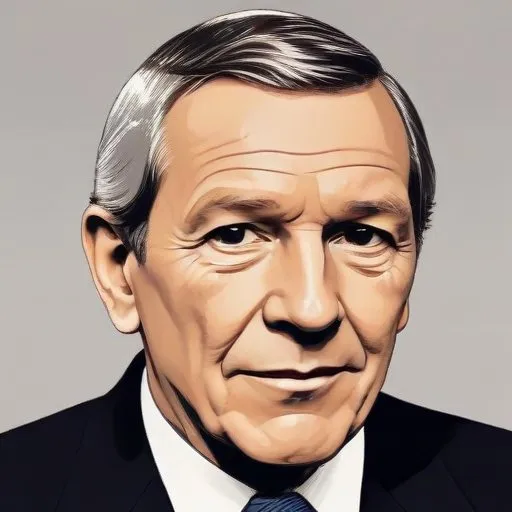
A prominent figure in American politics, serving as Senate Majority Leader and Chief of Staff to President Ronald Reagan, known for his role in the Watergate scandal and foreign policy expertise.
Known as the Great Conciliator, Howard Baker was a renowned American politician, diplomat, and photographer who left an indelible mark on American politics. He served as a United States Senator from Tennessee from 1967 to 1985, rising to the rank of Senate Minority Leader and then Senate Majority Leader.
Born on November 15, 1925, in Huntsville, Tennessee, Baker was the son of Dora Ladd Baker and Howard Baker Sr., a Republican member of the US House of Representatives. He attended The McCallie School in Chattanooga and later graduated from Tulane University in New Orleans. Baker was an alumnus of the Alpha Sigma Chapter of the Pi Kappa Phi fraternity.
during World War II, Baker trained at a U.S. Navy facility on the campus of the University of the South in Sewanee, Tennessee, in the V12 Navy College Training Program. He served as a lieutenant in the United States Navy and graduated from the University of Tennessee College of Law in 1949. That year, he was admitted to the Tennessee bar and began his law practice.
Baker began his political career in 1964, when he lost his bid for the Republican nomination for the U.S. Senate. However, he didn't let that setback deter him. He ran again in 1966 and won, becoming the first Republican to be elected to the U.S. Senate in Tennessee since the Reconstruction era.
Baker's Senate career was marked by his ability to broker compromises and enact legislation. He worked closely with Democratic senator Edmund Muskie to pass the Clean Air Act of 1970, a landmark piece of legislation that improved air quality across the United States.
In 1980, Baker sought the Republican presidential nomination but dropped out after the first set of primaries. However, his political career didn't slow down. From 1987 to 1988, he served as White House Chief of Staff for President Ronald Reagan, playing a key role in shaping the president's agenda.
From 2001 to 2005, Baker served as the United States Ambassador to Japan, strengthening relations between the two countries and promoting American interests abroad.
Baker was a moderate conservative who believed in the importance of bipartisanship and compromise. He was respected by his Democratic colleagues for his ability to work across the aisle and find common ground.
Baker received numerous awards and honors for his public service, including the Presidential Medal of Freedom, the highest civilian honor in the United States.
Howard Baker's legacy continues to inspire Americans today. He left behind a legacy of public service, bipartisanship, and compromise, reminding us that even in the most divisive of times, we can find common ground and work towards the greater good.
As the Great Conciliator, Baker's impact on American politics will be felt for generations to come, serving as a reminder that politics can be practiced with civility, respect, and compassion.
Born in 1911
The charismatic leader who championed conservative policies, helped end the Cold War, and is often credited with restoring American pride and optimism. He's also remembered for his folksy, actor-honed communication style.
Born in 1924
The 41st President of the United States, a decorated war hero and skilled diplomat, led the country through the end of the Cold War and Gulf War. He's known for his foreign policy expertise and "kinder, gentler nation" vision.
Born in 1913
The 38th President of the United States, a former football star and lawyer, is known for being the first vice president to assume the presidency under the 25th Amendment and for his controversial pardon of Richard Nixon. He's also remembered for his humble and accidental rise to the presidency.
Born in 1923
A renowned diplomat and strategist who played a pivotal role in shaping global politics during the Cold War era, known for his Realpolitik approach and brokering peace agreements .
94 Years Old
The 13th United States Secretary of Defense, a high-ranking government official, oversaw the US military during the Iraq War and was known for his controversial decisions and quotes. He's infamous for his "known unknowns" phrase.
85 Years Old
The 46th Vice President of the United States, a powerful and influential figure in American politics, known for his strong conservative stance and role in shaping the country's foreign policy during the War on Terror.
89 Years Old
The first African American to serve as Secretary of State, he played a crucial role in shaping US foreign policy during the Gulf War and War on Terror. He's also known for his diplomatic efforts and leadership in the military.
71 Years Old
The first African American woman to serve as Secretary of State, she played a crucial role in shaping US foreign policy during a tumultuous period, earning her a lasting legacy in international relations.
