


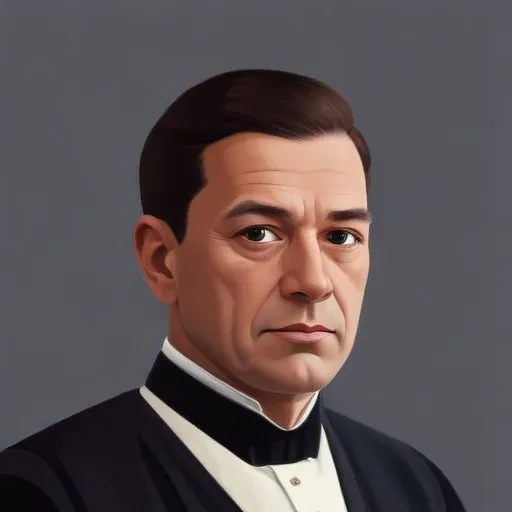
Governor-General of the Dutch East Indies during World War II, known for his attempts to re-establish Dutch colonial rule in Indonesia, leading to the Indonesian National Revolution.
Hubertus van Mook was a Dutch administrator in the East Indies, best known for serving as the Acting Governor-General of the Dutch East Indies from 1942 to 1948 during the Indonesian National Revolution. His liberal inclinations and sympathies towards Indonesian nationalism made him a significant figure in the region's history.
Born on May 30, 1894, in Semarang, Central Java, van Mook grew up in the East Indies and developed a deep connection with the region. He studied Indology at Leiden University, which laid the foundation for his future career in the colonial administration.
Van Mook's career in the colonial administration began in 1931 when he became a member of the Volksraad, an advisory body set up by the colonial administration. He spoke in favor of greater autonomy for the Dutch East Indies and equal treatment for different races. His progressive views earned him recognition, and he was appointed director of economic affairs from 1937 to 1941.
In 1941, van Mook was named the successor to Governor-General Alidius Tjarda van Starkenborgh Stachouwer and appointed Lieutenant Governor-General. Following the surrender of the East Indies to the Japanese in 1942, van Mook was given authority over the areas still unoccupied by the Japanese. He was later relieved of his lieutenant-governorship and became Minister of Colonies, but was reappointed Lieutenant Governor-General in 1944.
Van Mook's liberal inclinations and sympathies towards Indonesian nationalism made him a controversial figure among conservative Dutch. His policies were often met with distrust, and he was not given the full authority he desired. Despite this, he continued to advocate for greater autonomy and self-governance for the Dutch East Indies.
Van Mook's legacy is complex and multifaceted. He is remembered for his role in shaping the East Indies during a tumultuous period in history. His writings on Java and local folklore, particularly his work on Kota Gede, demonstrate his ability to examine and appreciate the cultures of the region.
Van Mook's son, Cornelius van Mook, studied marine engineering at the Massachusetts Institute of Technology. Little is known about van Mook's personal life beyond his professional career and public persona.
Van Mook's legacy extends beyond his administrative career. His advocacy for greater autonomy and self-governance paved the way for future generations of Indonesians and Dutch alike. His writings on local folklore and culture have contributed to a greater understanding and appreciation of the region's rich heritage.
Hubertus van Mook's life and career serve as a testament to the complexities of colonialism and the struggles for independence. His legacy continues to shape our understanding of the Dutch East Indies and its rich cultural heritage.
Born in 1901
Led Indonesia to independence from the Netherlands, serving as the country's first president and implementing a policy of nationalization and industrialization. He's known for his charismatic leadership and vision for a unified Indonesia.
Born in 1902
First Vice President of Indonesia, instrumental in the country's fight for independence from the Netherlands, and a key figure in shaping Indonesia's early years.
