


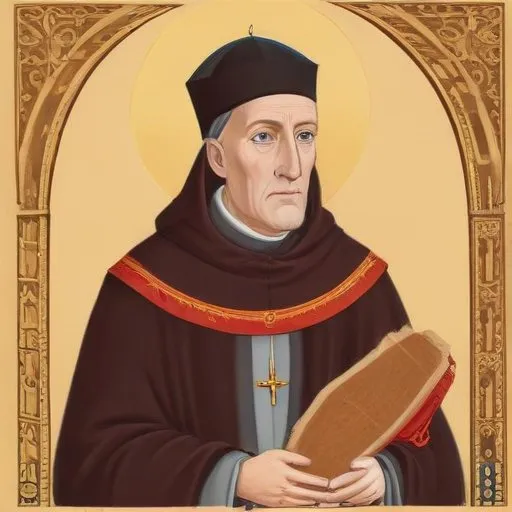
A 11th-century abbot who reformed the Cluniac Order, promoting spiritual renewal and establishing a network of monasteries across Europe. He's revered for his piety, wisdom, and administrative skills.
Hugh of Cluny, also known as Hugh the Great, was a visionary abbot who left an indelible mark on the medieval European landscape. As the Abbot of Cluny from 1049 to 1109, he was instrumental in shaping the course of monasticism, influencing papal policies, and fostering cultural and architectural innovations that continue to inspire awe.
Born in 1024 to a noble family in Burgundy, Hugh was destined for greatness. Recognizing his aversion to a life of chivalry, his father entrusted him to his granduncle Hugh, Bishop of Auxerre, for preparation for the priesthood. Under the bishop's guidance, Hugh received his early education at the monastery school attached to the Priory of St. Marcellus.
At the tender age of 14, Hugh entered the novitiate at Cluny, taking his monastic vows a year later. His rapid rise through the ranks was a testament to his exceptional abilities and devotion to the monastic life. He would eventually become prior of Cluny, preceding his election as abbot in 1049.
Hugh's tenure as abbot was marked by a series of groundbreaking achievements. He played a pivotal role in accompanying the Bishop of Toul, Pope-elect Bruno von Egisheim-Dagsburg, to Rome, where he was consecrated Pope Leo IX. This encounter cemented Hugh's position as a trusted advisor and mediator between the papacy and European monarchies.
In 1054, Hugh attended the Council of Tours, where he advocated for monastic reform and the promotion of Christian unity. His commitment to these ideals led to the construction of the third abbey church at Cluny, financed by Ferdinand I of León. This magnificent structure, consecrated by Pope Urban II in 1085, would become the largest in Europe for centuries.
Hugh's relationships with powerful monarchs, including Ferdinand I of León and Alfonso VI of León and Castile, yielded significant diplomatic dividends. He successfully negotiated the release of Alfonso from his brother Sancho's prison, brokered alliances, and facilitated the spread of Cluniac influence across Europe.
Hugh's close ties to Pope Urban II, who had been prior at Cluny under his guidance, enabled him to shape papal policies and promote the interests of the monastic order. This synergy facilitated the establishment of the Priory of St. Pancras in England, the first Cluniac house on English soil.
Hugh of Cluny's remarkable life and achievements left an enduring legacy in the realms of monasticism, politics, and culture. His visionary leadership, diplomatic prowess, and architectural innovations continue to inspire awe and admiration.
As a champion of monastic reform, Hugh's influence extended far beyond the walls of Cluny. His commitment to Christian unity and his role in shaping papal policies had far-reaching consequences for the medieval Catholic Church.
In conclusion, Hugh of Cluny's remarkable life and achievements serve as a testament to the power of vision, leadership, and diplomacy. As a profound thinker, builder, and diplomat, he remains an enduring figure in the annals of medieval European history.
"The Lord is the beginning and the end of our works; and it is He who has given us the power to perform them."
"A monk's life is a life of love, and love is the greatest of all virtues."
Born in 1521
The shortest-reigning pope in history, serving for only 13 days in 1590, he is remembered for his brief but tumultuous tenure.
