


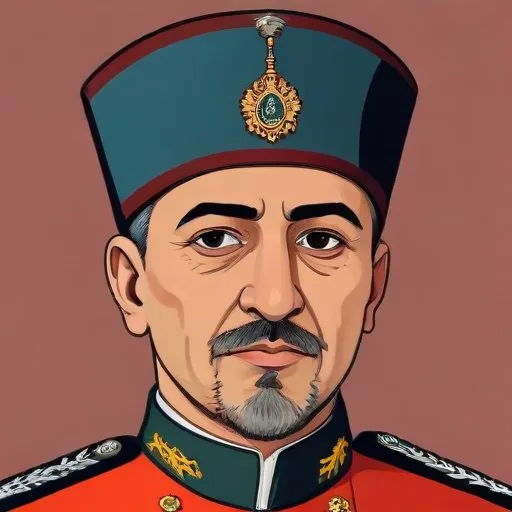
Ottoman Empire's military leader who led successful campaigns in Eastern Europe, particularly in Hungary and Croatia, expanding the empire's territories.
Known for leading a bold uprising against the Ottoman Empire's modernizing reforms, Husein Gradaevi is an iconic figure in Bosnian history. This fearless military commander fought for autonomy and self-governance, earning him the revered title "The Dragon of Bosnia" (Zmaj od Bosne).
Born on August 31, 1802, in the town of Gradačac, northern Bosnia, Husein Gradaevi was part of a prominent Bosnian noble family. His family's origins dated back to the 17th century, when they migrated from Buda, present-day Hungary, to Bosnia.
In the early 1820s, Gradaevi succeeded his relatives, including his father, as the captain of Gradačac. This position catapulted him to prominence, and by 1830, he became the spokesman for all Ottoman captains in Bosnia. His leadership skills were evident as he coordinated the defense against a possible Serbian invasion, following the Russo-Turkish War of 1828-1829.
Sultan Mahmud II's Tanzimat reforms, which abolished the Janissaries and weakened the nobility's privileges, sparked outrage among the Bosnian nobility. Gradaevi was chosen to lead the rebellion, which aimed to secure autonomy and self-governance for Bosnia. During this three-year uprising, Gradaevi's forces achieved a significant victory against the Ottoman field marshal in Kosovo.
The uprising ultimately failed, and all captaincies were abolished by 1835. Gradaevi was temporarily exiled to Austria but negotiated his return with the Sultan, allowing him to enter all Ottoman Empire territories except Bosnia. He died under controversial circumstances on August 17, 1834, and was buried in the Eyüp Cemetery in Istanbul.
Husein Gradaevi's life was marked by significant personal milestones, including his appointment as Vizier during the uprising and his reputation as a national hero among the Bosniaks.
Gradaevi's fight for autonomy and self-governance reflected his strong belief in the importance of regional identity and self-determination. His leadership and vision continue to inspire generations of Bosniaks and beyond.
Husein Gradaevi's legacy extends beyond his own time and region. His bravery and determination have inspired movements for autonomy and independence across the Balkans and beyond.
In conclusion, Husein Gradaevi's remarkable life and achievements have cemented his place as a Bosniak national hero and an iconic figure in Bosnian history. His courageous fight for autonomy and self-governance continues to inspire and motivate people around the world.
Born in 1861
The last Sultan of the Ottoman Empire, ruling from 1918 to 1922, known for his brief and tumultuous reign marked by the empire's collapse and eventual abolition.
Born in 1881
Founder of modern Turkey, leading the country's transition from the Ottoman Empire to a secular, democratic nation, and implementing sweeping reforms in education, law, and women's rights.
Born in 1881
Ottoman Empire's Minister of War and leader of the Young Turk revolution, known for his role in World War I and the Armenian Genocide.
Born in 1882
A Turkish general and politician who played a key role in the country's War of Independence and later served as the 5th Speaker of the Grand National Assembly of Turkey. He's known for his military victories and contributions to modern Turkey's foundation.
Born in 1876
A Turkish field marshal and politician who served as Prime Minister of the Turkish Provisional Government, playing a crucial role in the country's transition from Ottoman Empire to modern republic. He's known for his military victories and political leadership during a tumultuous period in Turkish history.
