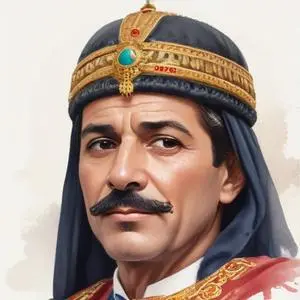
Hussein of Jordan: A Life of Leadership and Diplomacy
A Reign of Strength and Vision
King Hussein bin
Talal of Jordan is renowned for his remarkable leadership and diplomatic prowess, which earned him the respect and admiration of world leaders and his people alike. As the 40th generation direct descendant of the Islamic prophet Muhammad, Hussein's legacy is deeply rooted in the Hashemite dynasty, which has ruled Jordan since 1921.
Early Life and Accession
Born on November 14, 1935, in Amman, Hussein was the eldest child of Talal bin Abdullah and Zein al-Sharaf bint Jamil. His early education in Amman was followed by schooling abroad, where he developed a strong foundation in politics and governance. After his father, Talal, became king in 1951, Hussein was named heir apparent. However, when Talal's illness led to his abdication in 1952, a regency council was appointed until Hussein came of age. At just 17, Hussein was enthroned on May 2, 1953, beginning a reign that would last nearly five decades.
A Constitutional Monarch with a Vision
As a constitutional monarch with wide executive and legislative powers, Hussein introduced a liberal experiment in 1956, allowing the formation of Jordan's first democratically elected government. Although the experiment was short-lived, it marked a significant step towards democratic governance in the region. Hussein went on to rule Jordan through periods of turmoil and transformation, including the 1967 Six-Day War, which led to Jordan's loss of the West Bank.
A Legacy of Peace and Diplomacy
One of Hussein's most significant achievements was his role in brokering peace in the Middle East. In 1994, he became the second Arab head of state to sign a peace treaty with Israel. This historic agreement marked a major milestone in the region's quest for peace and stability. Throughout his reign, Hussein was committed to fostering diplomatic relations with neighboring countries and international partners, earning him the respect and admiration of world leaders.
Personal Life and Family
Hussein was married four times and fathered eleven children. His personal life was marked by a strong sense of family and dedication to the well-being of his people. As a father and a leader, Hussein embodied the values of compassion, wisdom, and courage.
Legacy and Impact
King Hussein's legacy extends far beyond his impressive diplomatic achievements. He played a crucial role in shaping Jordan's modern identity, promoting economic development, and fostering a sense of national pride. His commitment to education, healthcare, and social welfare has left a lasting impact on the lives of the Jordanian people.
Quotes and Memorable Sayings
- "Jordan's strength is not in its army, but in its people."
- "Peace is not just the absence of war, but the presence of justice and equality."
Award and Honors
King Hussein was awarded numerous honors and accolades for his outstanding leadership and diplomatic achievements, including:
- The Royal Victorian Chain (1976)
- The Presidential Medal of Freedom (1994)
- The Order of the White Eagle (1995)
Historical Context and Legacy
King Hussein's reign was marked by significant regional and global events, including the Cold War, the Arab-Israeli conflict, and the rise of political Islam. Through it all, he remained a steadfast leader, committed to the welfare and prosperity of his people. Today, King Hussein is remembered as a visionary leader who played a crucial role in shaping the modern Middle East. His legacy continues to inspire generations of Jordanians and people around the world.
FAQ
What was King Husseins role in Middle Eastern politics?
King Hussein of Jordan played a crucial role in Middle Eastern politics, serving as a mediator between Arab states and the West, and working to maintain stability in the region.
What were some of King Husseins most significant accomplishments?
King Husseins most significant accomplishments include maintaining peace with Israel, promoting economic development in Jordan, and supporting the Palestinian cause.
How did King Hussein modernize Jordan?
King Hussein modernized Jordan through a series of reforms, including the development of infrastructure, education, and healthcare, which transformed the country into a modern state.
What was King Husseins relationship like with other world leaders?
King Hussein was a respected figure on the world stage, known for his diplomatic skills and his ability to build relationships with other world leaders, including US presidents and European leaders.
How is King Hussein remembered in Jordanian history?
King Hussein is remembered as a visionary leader who played a crucial role in shaping Jordans history and ensuring its stability and prosperity.