


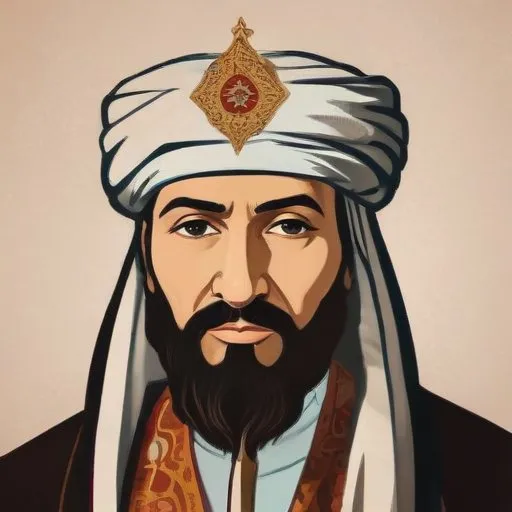
The Sultan of the Ottoman Empire from 1640 to 1648, known for his extravagance, tyranny, and military failures, which led to his eventual deposition and assassination.
Ibrahim of the Ottoman Empire, also known as Ibrahim the Mad, was the Sultan of the Ottoman Empire from 1640 until 1648. He is remembered for his eccentric and extravagant lifestyle, which led to a reign of excess and eventual downfall.
Ibrahim was born on November 5, 1615, in Constantinople, to Sultan Ahmed I and his wife, Ksem Sultan, an ethnic Greek originally named Anastasia. After his father's sudden death, Ibrahim's uncle Mustafa I became the new Sultan, and Ibrahim was confined in the Kafes, a type of palace prison, where he spent most of his early life.
Despite the fear of being executed, Ibrahim's life was saved by the intercession of his mother, Ksem Sultan, and he eventually succeeded his brother Murad IV as the Sultan of the Ottoman Empire in 1640. Ibrahim was the sole surviving prince of the dynasty, and his accession marked the beginning of a new era of excess and extravagance.
Ibrahim's reign was characterized by his love of luxury and extravagance. He spent lavishly on palace renovations, festivals, and feasts, earning him the nickname "Ibrahim the Mad". He was known for his elaborate ceremonies, which often lasted for days, and his love of fine silks, jewels, and other precious materials.
One of his most notable excesses was his fascination with the harem. He built a lavish palace for his mistresses, which became a symbol of his decadence. His love of women led to a series of scandals, including the murder of his favorite mistress, who was accused of witchcraft.
Ibrahim's extravagance and excess eventually led to his downfall. His lavish spending and poor decision-making led to a decline in the Ottoman Empire's economy and military power. In 1648, Ibrahim was deposed and murdered by a group of Janissaries, who were dissatisfied with his rule.
Despite his tumultuous reign, Ibrahim left a lasting legacy on the Ottoman Empire. His love of architecture and art led to the construction of several magnificent buildings, including the famous Blue Mosque. His excesses may have been extreme, but they also contributed to the development of Ottoman culture and architecture.
"I am the Sultan, and I will do as I please."
"Luxury is the key to happiness."
Ibrahim's legacy extends beyond the Ottoman Empire. His love of architecture and art has inspired generations of artists and architects. His excesses may have been extreme, but they also contributed to the development of Ottoman culture and architecture.
Today, Ibrahim is remembered as a symbol of excess and extravagance, a reminder of the dangers of unchecked power and greed. Despite his flaws, he remains an important figure in Ottoman history, and his legacy continues to inspire and fascinate people around the world.
Born in 1494
Ruling the Ottoman Empire at its peak, he expanded its borders, conquered Belgrade, and laid siege to Vienna, earning a reputation as a brilliant military strategist and statesman. He also codified laws and reformed the empire's administration.
Born in 1699
The Ottoman Empire's 25th Sultan, ruling from 1754 to 1757, known for his brief and uneventful reign, marked by a lack of significant reforms or military campaigns.
Born in 1326
The founder of the Ottoman Empire's expansionist era, known for conquering much of the Balkans and establishing the Ottoman state as a dominant power in the region.
Born in 1664
Ottoman Empire's 22nd ruler, known for his military campaigns in Europe, particularly the Great Turkish War, and his eventual defeat at the Battle of Zenta.
Born in 1643
The 22nd Sultan of the Ottoman Empire, ruling from 1691 to 1703, known for his military campaigns in Europe and his architectural legacy, including the construction of the Ahmed III Fountain.
