


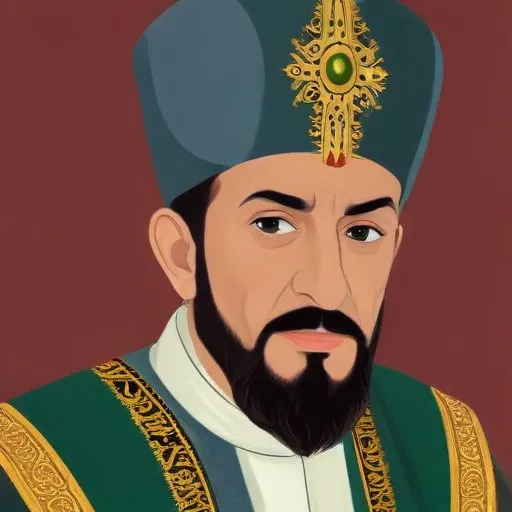
The 22nd Sultan of the Ottoman Empire, ruling from 1691 to 1703, known for his military campaigns in Europe and his architectural legacy, including the construction of the Ahmed III Fountain.
Ahmed II, also known as Amedi, was the Sultan of the Ottoman Empire from 1691 to 1695. He is remembered for his efforts to reform the empire's tax system, military, and government, as well as his wars against the Habsburgs.
Born on either 25 February 1643 or 1 August 1642, Ahmed II was the son of Sultan Ibrahim and Muazzez Sultan. Alongside his brothers Mehmed and Suleiman, Ahmed was circumcised on 21 October 1649. However, during the reigns of his older brothers, Ahmed was imprisoned in Kafes, where he spent almost 43 years.
Upon ascending to the throne, Ahmed II devoted his attention to the wars against the Habsburgs and related foreign policy, governmental, and economic issues. Two significant reforms during his reign were the introduction of the lifelong tax farm system (malikne) and the overhaul of the tax system to accommodate the capabilities of taxpayers affected by the latest wars.
Ahmed II relied heavily on Kprlzade Fazl Mustafa Pasha, whom he confirmed as grand vizier upon his accession to the throne. Fazl Mustafa Pasha, from the Kprl family of grand viziers, was an able administrator and military commander. He removed and executed dozens of corrupt state officials and replaced them with loyal men, reformed troop mobilization, and increased the pool of conscripts available for the army.
During Ahmed II's reign, the military frontier on the Danube River reached a stalemate. The Habsburgs were unable to advance south of the river, while the Ottomans attempted, ultimately unsuccessfully, to regain the initiative north of it. Despite this, Ahmed II's reign saw the recovery of Belgrade under his predecessor, Suleiman II.
Ahmed II's reforms and military campaigns had a lasting impact on the Ottoman Empire. His tax reforms and reliance on able administrators like Fazl Mustafa Pasha strengthened the empire's economy and government. Although his military campaigns were not entirely successful, they demonstrated the empire's resilience and determination to protect its territories.
Ahmed II's legacy serves as a testament to his commitment to reforming and strengthening the Ottoman Empire, even in the face of adversity.
Born in 1717
The Ottoman Empire's 18th-century ruler, known for his military campaigns and attempts to modernize the empire, particularly in the fields of education and administration. He also fought against the Russian Empire and lost significant territory.
Born in 1643
The 22nd Sultan of the Ottoman Empire, ruling from 1691 to 1703, known for his military campaigns in Europe and his architectural legacy, including the construction of the Ahmed III Fountain.
Born in 1789
Reformed the Ottoman Empire's military and administrative systems, modernizing the country and ending the Janissary corps' power. He also reformed the education system and encouraged Western-style learning.
Born in 1699
The Ottoman Empire's 25th Sultan, ruling from 1754 to 1757, known for his brief and uneventful reign, marked by a lack of significant reforms or military campaigns.
Born in 1546
The Ottoman Empire's 12th ruler, known for his lavish spending, cultural achievements, and military conquests that expanded the empire's borders, including the capture of Cyprus and parts of Eastern Europe.
Born in 1642
The Ottoman sultan who ruled from 1648 to 1687, known for his military campaigns that expanded the empire's borders, including the conquest of Crete and parts of Poland. He was also known for his cultural and architectural achievements, including the construction of several mosques and palaces.
Born in 1642
The Ottoman Empire's 11th Sultan, ruling from 1687 to 1691, known for his brief but tumultuous reign marked by wars with Austria and Poland. He was overthrown and eventually strangled.
