


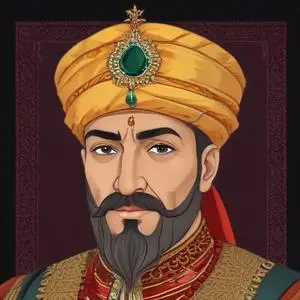
The Ottoman sultan who ruled from 1648 to 1687, known for his military campaigns that expanded the empire's borders, including the conquest of Crete and parts of Poland. He was also known for his cultural and architectural achievements, including the construction of several mosques and palaces.
Mehmed IV, also known as Mehmed the Hunter, was the Sultan of the Ottoman Empire from 1648 to 1687, reigning for an impressive 39 years and earning the title of the second-longest reigning Sultan in Ottoman history after Suleiman the Magnificent. He is renowned for his military conquests, territorial expansion, and revival of the empire's fortunes during the Kprl era.
Mehmed IV was born on January 2, 1642, at Topkap Palace, Constantinople, to Sultan Ibrahim and Turhan Sultan, a concubine of Russian origin. His early life was marked by a dramatic incident, where his father, enraged by a quarrel with his mother, tore Mehmed from her arms and flung him into a cistern, leaving him with a lifelong scar on his head.
At the tender age of six, Mehmed ascended to the throne in 1648, amidst a volatile time for the Ottoman dynasty. On October 21, 1649, Mehmed, along with his brothers Suleiman and Ahmed, underwent circumcision, marking an important rite of passage.
Mehmed IV's reign was characterized by military campaigns and territorial expansion. He earned the title of gazi, or holy warrior, for his role in numerous conquests. During his reign, the Ottoman Empire reached its peak territorial expansion in Europe, with Mehmed IV successfully conquering parts of Poland, Ukraine, and Hungary.
In addition to his military prowess, Mehmed IV was known for his piety and strong faith. He was a devout Muslim and implemented various reforms to strengthen the empire's Islamic roots. His reign also saw the construction of several important architectural landmarks, including the famous Edirnekapı Mihrimah Sultan Mosque.
Mehmed IV's love for hunting was renowned, and he earned the nickname "Avcı" or "The Hunter." He developed a keen interest in hunting from a young age and would often spend weeks at a time on hunting expeditions, accompanied by his loyal companions and courtiers.
Hunting was not only a passion for Mehmed IV but also a way to bond with his nobles and officials. He would often host lavish hunting parties, where the elite of the empire would gather to hunt and feast together. These events were significant in fostering relationships and alliances within the Ottoman elite.
In 1687, Mehmed IV was overthrown by soldiers disillusioned with the course of the ongoing War of the Holy League. He was exiled to Edirne, where he lived in relative seclusion until his death on January 6, 1693, at the age of 51.
Despite his eventual downfall, Mehmed IV's legacy as a pious and powerful Sultan remains. He played a crucial role in shaping the Ottoman Empire's history, and his military conquests and territorial expansion continue to inspire awe.
Mehmed IV's reign marked a significant turning point in Ottoman history, as the empire reached its peak territorial expansion and experienced a resurgence in its fortunes. His legacy is a testament to the power and grandeur of the Ottoman Empire during its golden age.
Mehmed IV's story serves as a reminder of the complexities and intricacies of Ottoman history, where politics, faith, and passion intertwined to shape the course of an empire.
Born in 1494
Ruling the Ottoman Empire at its peak, he expanded its borders, conquered Belgrade, and laid siege to Vienna, earning a reputation as a brilliant military strategist and statesman. He also codified laws and reformed the empire's administration.
Born in 1643
The 22nd Sultan of the Ottoman Empire, ruling from 1691 to 1703, known for his military campaigns in Europe and his architectural legacy, including the construction of the Ahmed III Fountain.
Born in 1699
The Ottoman Empire's 25th Sultan, ruling from 1754 to 1757, known for his brief and uneventful reign, marked by a lack of significant reforms or military campaigns.
Born in 1326
The founder of the Ottoman Empire's expansionist era, known for conquering much of the Balkans and establishing the Ottoman state as a dominant power in the region.
Born in 1611
A 17th-century Ottoman explorer and writer who traveled extensively throughout the Middle East, Europe, and Africa, documenting his journeys and cultural observations in a 10-volume book. He is most known for his vivid descriptions of people, places, and customs, providing valuable insights into the social and cultural history of the time.
