


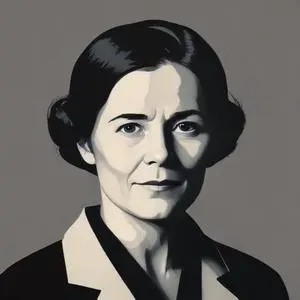
Pioneering Danish scientist who discovered the Earth's inner core and developed methods to study seismic waves, revolutionizing our understanding of the planet's internal structure.
Inge Lehmann, a trailblazing Danish seismologist and geophysicist, is renowned for her groundbreaking discovery of the solid inner core within the molten outer core of the Earth. This seminal finding, made in 1936, has had a profound impact on our understanding of the Earth's internal structure and composition.
Inge Lehmann was born on May 13, 1888, in Østerbro, a district of Copenhagen, Denmark. She grew up in a family with a strong intellectual tradition, with her father, Alfred Georg Ludvik Lehmann, being an experimental psychologist. Lehmann's mother, Ida Sophie Trsløff, was a housewife, and her maternal grandfather, Hans Jakob Torsløff, was a descendant of an old Danish family with a long line of priests.
Lehmann received her education at Flæskov, a progressive high school that taught women and men the same subjects together. This unique educational environment, led by Hanna Adler, Niels Bohr's aunt, had a profound influence on her intellectual development. Lehmann's academic prowess was evident from an early age, and she achieved a first-rank mark in the entrance exam for Copenhagen University at the age of 18.
Lehmann began her studies in mathematics, chemistry, and physics at the University of Copenhagen in 1907. She continued her studies in mathematics at Newnham College, Cambridge, from 1910 to 1911, where she faced gender-based adversities, including being barred from fully participating in her studies and achieving higher positions of education. Despite these challenges, Lehmann's determination and passion for her work led her to make significant contributions to the field of seismology.
Inge Lehmann's groundbreaking discovery has had a lasting impact on our understanding of the Earth's internal structure and composition. Her work has inspired generations of scientists, and her legacy extends beyond the scientific community.
The seismic discontinuity in the speed of seismic waves at depths between 190 and 250 km is named the Lehmann discontinuity in her honor, recognizing her pioneering work in the field of seismology. Lehmann's contributions have paved the way for future generations of women in science, and her story serves as a testament to the power of determination and perseverance.
Born in 1900
Developed the Richter scale, a logarithmic measure of earthquake magnitude that revolutionized seismology and helped predict earthquake severity. This scale remains a crucial tool in earthquake research and disaster preparedness today.
Born in 1889
Developed the first accurate scale to measure earthquake magnitudes, revolutionizing seismology and enabling scientists to better understand and predict earthquakes.
Born in 1908
Pioneering geologist and geophysicist who transformed our understanding of the Earth's surface, proposing the theory of plate tectonics and revolutionizing the field of geology.
