


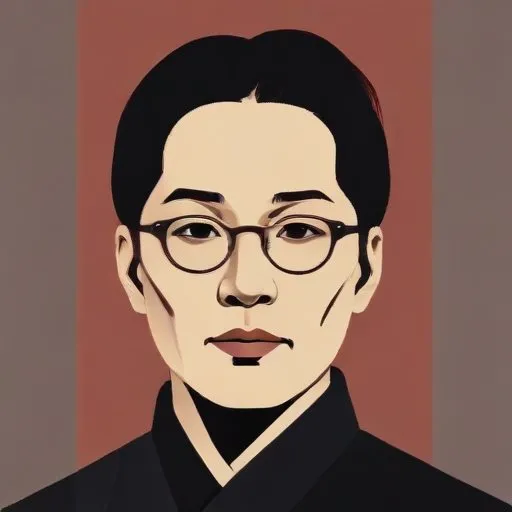
A South Korean-German composer and educator who blended Eastern and Western musical traditions, creating a unique sound that resonated globally. He's renowned for his symphonies and chamber music.
Isang Yun, a Korean-born composer, left an indelible mark on the world of classical music with his innovative and eclectic style, which blended traditional Korean folk elements with modern Western techniques. Best known for his symphonic works, Yun's compositions continue to captivate audiences with their emotional depth and technical complexity.
Born on September 17, 1917, in Sancheong, Korea, Yun's musical journey began at the age of 13, when he started studying the violin. Despite his father's initial disapproval, Yun pursued music with passion and dedication, eventually enrolling in a business school while continuing his musical studies to appease his father.
In 1935, Yun moved to Osaka, Japan, where he studied cello, music theory, and composition at the Osaka College of Music. This period laid the foundation for his future success, as he was exposed to a wide range of musical styles and techniques. Yun's brief stint in Tokyo, studying under Tomojiro Ikenouchi, further honed his skills as a composer.
As the Pacific War began in 1941, Yun returned to Korea, where he participated in the Korean independence movement. His involvement led to his arrest and imprisonment for two months in 1943. After Korea's liberation from Japanese rule in 1945, Yun dedicated himself to welfare work, establishing an orphanage for war orphans and teaching music in Tongyeong and Busan.
In the 1950s, Yun's talent and dedication earned him recognition on the international stage. He received the Seoul City Culture Award in 1955 and later traveled to Europe to further his musical studies. At the Paris Conservatory, he studied composition under Tony Aubin and Pierre Revel, and later at the Musikhochschule Berlin, where he honed his craft under the guidance of renowned instructors.
Yun's compositions are characterized by their unique blend of traditional Korean folk elements, such as the use of pentatonic scales and Asian-inspired melodies, with modern Western techniques, including atonality and serialism. Some of his notable works include:
Yun's compositions have been performed by renowned ensembles and soloists, including the Berlin Philharmonic, the Tokyo Symphony Orchestra, and the violinist Yehudi Menuhin.
Isang Yun's legacy extends beyond his remarkable compositions to his tireless advocacy for cultural exchange and understanding. He played a pivotal role in promoting Korean music and culture globally, paving the way for future generations of Korean composers. Yun's influence can be seen in the works of contemporary Korean composers, such as Unsuk Chin and Sung-Hyuk Cho.
Throughout his life, Yun received numerous awards and honors, including the Seoul City Culture Award, the Korean National Prize for Arts, and the Order of Cultural Merit from the Korean government. His music continues to inspire audiences worldwide, solidifying his place as one of the most important Korean-born composers of the 20th century.
97 Years Old
A pioneer of electronic and avant-garde music, this composer pushed boundaries with unconventional sounds and performances, influencing generations of musicians and artists.
Born in 1925
A renowned French musician who revolutionized classical music with his avant-garde compositions and innovative conducting style, pushing boundaries and redefining the genre.
Born in 1923
A visionary composer and educator who pushed the boundaries of classical music with his avant-garde and innovative works, blending dissonance and harmony in unique ways.
Born in 1922
A visionary composer who merged mathematics and music, creating complex, avant-garde works that pushed the boundaries of sound and performance.
Born in 1926
A pioneer of indeterminacy in music, creating subtle, atmospheric soundscapes that defy traditional composition, and teaching generations of musicians to think outside the box.
Born in 1883
A pioneering composer who blended classical and modernist styles, creating innovative, avant-garde works that explored new sounds and techniques.
Born in 1926
A renowned composer and educator, he is celebrated for his innovative and eclectic style, blending modernist and traditional elements in his operas, symphonies, and chamber music.
Born in 1918
A German composer who blended avant-garde and traditional styles, creating complex, eclectic works that pushed musical boundaries. He's most famous for his opera "Die Soldaten".
