


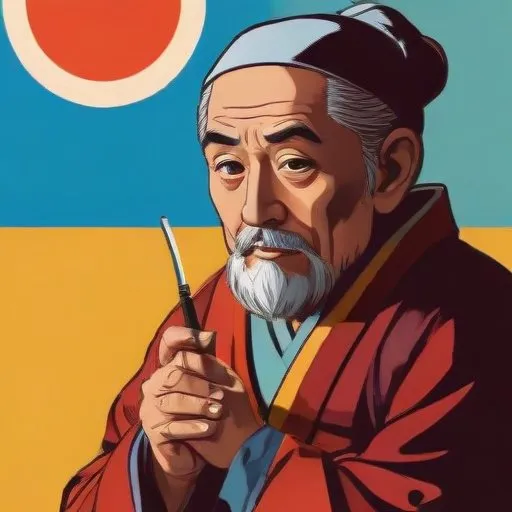
A 17th-century Confucian scholar who reinterpreted Confucian classics to emphasize individual moral development and self-cultivation, influencing Japanese thought and education.
It Jinsai, a renowned Japanese Confucian philosopher, is celebrated for his fearless advocacy of human emotions and his groundbreaking metaphysical framework that highlights the infinite creative potential of a unitary generative force. Through his scholarship, Jinsai challenged the prevailing philosophical currents of his time, earning him a prominent place in the annals of Japanese and East Asian philosophical history.
Born on August 30, 1627, in Kyoto, Japan, Jinsai was the eldest son of a merchant family. Although little is known about his family's commercial activities, it is evident that Jinsai's upbringing provided him with the financial stability to pursue his intellectual interests.
Jinsai's philosophical legacy is deeply rooted in his critique of the Song dynasty Chinese philosopher Zhu Xi (1130-1200). He saw Zhu Xi's teachings as flawed and instead developed a philosophical vision centered on a profound understanding of key terms in the Analects and the Mencius. This novel approach gave rise to Jinsai's own school of thought, known as the Kogigaku.
Jinsai's philosophical contributions are perhaps most notable for their unwavering emphasis on the validity of human emotions. In an era where emotional restraint was often valorized, Jinsai's willingness to acknowledge and celebrate the emotional spectrum of human experience marked a significant departure from the norm.
At the heart of Jinsai's philosophical system lies the concept of ichigenki, a unitary generative force that pervades all of existence and is characterized by infinite creative potential. This metaphysical framework allowed Jinsai to develop a nuanced understanding of the world, one that was both deeply rooted in Confucian tradition and yet boldly innovative.
Jinsai's ideas have had a profound impact on the development of Confucian thought in Japan and beyond. His work has been compared to that of the Qing dynasty scholar Dai Zhen (1724-1777), and his legacy continues to be felt in the realms of East Asian philosophy and intellectual history.
Jinsai's magnum opus, the Gom Jigi (The Meanings of Philosophical Terms in the Analects and Mencius), is a testament to his intellectual rigor and philosophical acuity. This work, along with his other writings, has cemented Jinsai's position as one of the most influential Confucian scholars of the seventeenth century.
While Jinsai's ideas are often associated with the Kogaku movement, which included thinkers such as Yamaga Sok (1622-1685) and Ogy Sorai (1666-1728), it is essential to understand his philosophical vision on its own terms. Jinsai's unique synthesis of Confucian thought and innovative metaphysics sets him apart from his contemporaries.
Through his remarkable life and scholarship, It Jinsai has left an indelible mark on the world of Confucian philosophy. His fearless advocacy of human emotions, his innovative metaphysics, and his profound impact on East Asian intellectual history ensure his continued relevance and importance in the present day.
Born in 1657
A prominent Confucian scholar and statesman who served as a chief advisor to the shogun, known for his efforts to reform Japanese politics and economy. He also wrote extensively on history, philosophy, and literature.
