


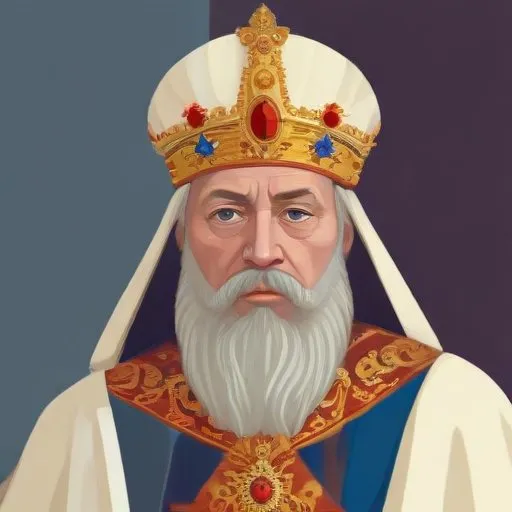
The last of the weak and ineffective rulers of the House of Romanov, known for being mentally disabled and used as a puppet by his sister Sophia, who ruled in his place.
Ivan V Alekseyevich, the youngest son of Tsar Alexis I of Russia, is primarily known for his titular reign as the Tsar of all Russia from 1682 to 1696, jointly ruling with his younger half-brother Peter I. Despite his physical and mental challenges, Ivan's reign was marked by turmoil, power struggles, and a series of events that shaped the future of Russia.
Born on August 27, 1666, in Moscow, Ivan was the youngest son of Tsar Alexis I and his first wife, Maria Miloslavskaya. His early life was marked by tragedy, with the death of his eldest brother Alexei at the age of 15 in 1670. This made his second brother, Feodor, the next in line to the throne.
When Feodor died without an heir in 1682, a crisis of succession emerged. Ivan, the next oldest brother, was deemed unfit to rule due to his physical and mental disabilities. This sparked a power struggle between the families of Ivan's mother, Maria Miloslavskaya, and Peter's mother, Natalya Naryshkina. The church and the Naryshkins supported Peter's claim to the throne, while the Miloslavski family and Ivan's older sister, Sofia Alekseyevna, fought for Ivan's right to rule.
Rumors of Feodor's poisoning and Ivan's murder spread throughout Moscow, fueling the Moscow Uprising of 1682. The streltsy, a military corps, stormed the Kremlin, demanding that Ivan be named tsar. The uprising subsided only after Ivan appeared in person, proving he was alive and well. A compromise was reached, declaring Ivan and Peter co-tsars, with a regency government until they came of age.
Despite his titular role, Ivan's reign was marked by significant events that shaped Russia's future. During his co-rulership with Peter, the government implemented reforms, expanded trade, and strengthened the military. Ivan's half-brother Peter would go on to become one of Russia's most influential leaders, modernizing the country and earning the title "Peter the Great."
Ivan V's reign, although marked by turmoil and power struggles, played a significant role in shaping Russia's future. His co-rulership with Peter I laid the foundation for Peter's eventual rise to power and his subsequent modernization of Russia. Ivan's legacy serves as a reminder of the complexities of royal succession and the importance of effective leadership in times of crisis.
Ivan V's story is a testament to the intricate web of politics, family dynamics, and power struggles that defined 17th-century Russia. Despite his physical and mental challenges, Ivan's reign left an indelible mark on Russian history, paving the way for the country's future growth and development.
Born in 1672
Reformed Russia's government, military, and culture, transforming it into a major European power. Known for modernizing and westernizing the country through numerous reforms and founding St. Petersburg.
Born in 1684
Wife of Peter the Great, she played a crucial role in his reign and later became the Empress of Russia, ruling from 1725 to 1727. She was a strong supporter of her husband's modernization policies.
Born in 1666
The last of the weak and ineffective rulers of the House of Romanov, known for being mentally disabled and used as a puppet by his sister Sophia, who ruled in his place.
