


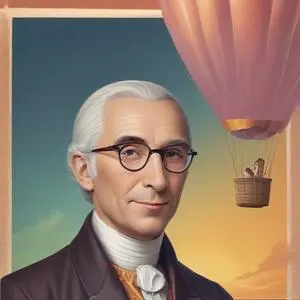
Co-inventor of the hot air balloon, credited with conducting the first successful human flight in 1783, paving the way for modern aviation.
Imagine soaring through the skies, witnessing the world from a perspective previously unimaginable. This vision became a reality thanks to Jacques-Etienne Montgolfier, the innovative French inventor and paper manufacturer who, along with his brother Joseph-Michel, revolutionized aviation with the invention of the hot air balloon.
In 1782, the Montgolfier brothers embarked on an experiment that would change the course of history. Inspired by the works of Archimedes and the observation of smoke rising from a fire, they designed a balloon that used hot air to lift off the ground. On November 21, 1783, they launched the first successful flight, carrying a sheep, a duck, and a rooster into the skies above Paris. The flight lasted for 10 minutes, reaching an altitude of 6,000 feet, and paved the way for human flight.
Born on January 6, 1745, in Annonay, France, Jacques-Etienne Montgolfier was the 12th of 16 children. His family owned a paper mill, which sparked his interest in science and technology from an early age. Montgolfier's fascination with flight was further fueled by his observation of birds in flight and the study of aerodynamics.
The Montgolfier brothers' invention not only opened the doors to human flight but also paved the way for modern aviation. Their innovative spirit and perseverance inspired future generations of inventors, engineers, and explorers. Today, the Montgolfier brothers are celebrated as heroes of aviation, with their invention recognized as a groundbreaking achievement in the history of flight.
Montgolfier's work embodies the spirit of curiosity and innovation. He believed that science and technology could be harnessed to improve the human condition and push the boundaries of human knowledge. His invention of the hot air balloon demonstrated the power of human ingenuity and the importance of perseverance in the face of adversity.
The Montgolfier brothers' achievement came at a time of great scientific and intellectual fervor in Europe. Their invention captivated the imagination of the public and inspired a new generation of inventors and explorers. Today, the Montgolfier brothers are remembered as pioneers in the field of aviation, and their legacy continues to inspire innovation and progress.
Montgolfier's work can be compared to that of other prominent inventors and scientists of his time, such as Benjamin Franklin and Antoine Lavoisier. While they made significant contributions to their respective fields, Montgolfier's invention of the hot air balloon marked a fundamental shift in human understanding of flight and paved the way for modern aviation.
Montgolfier's story serves as a powerful reminder of the importance of perseverance and innovation. His determination to push the boundaries of human knowledge and achieve the impossible continues to inspire people around the world. As we look to the skies, we are reminded of the power of human ingenuity and the limitless possibilities that await us.
Born in 1740
A French inventor credited with creating the first successful human-carrying flight technology, revolutionizing transportation and exploration. This innovation paved the way for modern aviation.
Born in 1744
A French soldier, biologist, and academic who developed a theory of inheritance of acquired characteristics, proposing that organisms adapt to their environment and pass on those traits to their offspring.
Born in 1700
A French priest and physicist who studied electricity and invented the electrometer, a device that measures electric charge. He's also known for his work on the Leyden jar, a precursor to modern capacitors.
Born in 1749
Developed nebular hypothesis of the origin of the solar system and formulated Laplace's equation, a fundamental concept in mathematics and physics. He's considered the founder of celestial mechanics.
Born in 1706
A founding father of the United States, he was a leading figure in the Enlightenment, known for his groundbreaking inventions, scientific discoveries, and influential writings. He played a key role in shaping American history and politics.
