


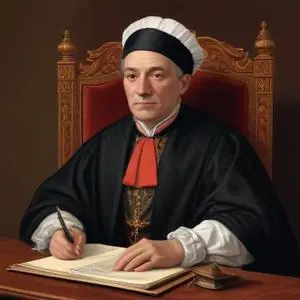
A wealthy merchant and banker who dominated the European economy during the Renaissance, financing royal dynasties and amassing a vast fortune.
Jakob Fugger, also known as Jakob Fugger the Rich, was a German merchant, mining entrepreneur, and banker who dominated the European economy during the Renaissance. Born on March 6, 1459, in Augsburg, Germany, Fugger's business empire spanned across the continent, earning him the reputation as one of the wealthiest individuals of his time.
Fugger's journey to success began at the age of 14, when he embarked on an educational journey to Venice. This experience not only broadened his horizons but also instilled in him a deep understanding of international trade and finance. Upon returning to Augsburg, Fugger leveraged his knowledge to expand the family firm, which had been established by his ancestors.
Fugger's innovative approach to banking and trade enabled him to establish a vast network of business operations that stretched across Europe. He forged strategic alliances with powerful monarchs, including the Habsburg dynasty, and the Roman Curia, providing financial services that facilitated their conquests and ambitions.
His entrepreneurial spirit led him to diversify into mining, with operations in Tyrol, Bohemia, and Hungary. The extraction of silver, copper, and quicksilver not only generated immense wealth but also cemented his position as a leader in the industry.
Fugger's vision extended beyond European borders. He participated in the first German merchant expedition to India, partnering with the Portuguese fleet to explore new trade routes. Although the venture was not without its challenges, it marked a significant milestone in the history of global commerce.
In 1525, Fugger supported a Spanish trade expedition to the Maluku Islands, further solidifying his reputation as a pioneer in international trade.
Jakob Fugger's legacy extends far beyond his impressive wealth, estimated to be around 400 billion in today's money. His innovative business practices, strategic alliances, and entrepreneurial spirit transformed the European economy, setting the stage for modern capitalism.
Fugger's influence can be seen in the development of international trade, finance, and commerce, earning him a place among the most significant figures of the Renaissance.
Fugger's personal life was marked by his elevation to Grand Burgher of Augsburg through marriage. He was also a cleric, holding several prebends, which granted him a unique perspective on the world of finance and trade.
Throughout his life, Fugger remained committed to his family and business, leaving behind a lasting legacy that continues to inspire entrepreneurs and business leaders today.
Fugger's approach to business was rooted in his strong work ethic and innovative spirit. He firmly believed in the importance of calculated risk-taking, strategic planning, and adapting to changing market conditions.
His legacy serves as a testament to the power of entrepreneurial vision, perseverance, and strategic thinking, inspiring generations of business leaders and entrepreneurs.
Fugger's impact on modern society is multifaceted. His contributions to international trade, finance, and commerce have shaped the global economy, influencing the way business is conducted today.
His legacy serves as a reminder of the importance of innovation, risk-taking, and strategic thinking in achieving success, inspiring future generations of entrepreneurs and business leaders.
In conclusion, Jakob Fugger's remarkable life and achievements have left an indelible mark on the world of business and commerce, cementing his position as one of the most influential figures of the Renaissance.
Born in 1483
A German monk and priest who sparked the Protestant Reformation, challenging Catholic Church authority and shaping Western Christianity. He's famous for nailing 95 theses to a church door, sparking a religious revolution.
Born in 1500
Ruling over a vast empire from 1519 to 1556, he was a powerful and influential leader who played a crucial role in shaping European politics and religion. He is most known for his efforts to unify Christian Europe and defend it against the Ottoman Empire.
Born in 1452
Renaissance mastermind behind iconic works like the Mona Lisa and The Last Supper, who revolutionized art, science, and engineering with his inventive and curious nature.
Born in 1475
Renaissance master of iconic works like the ceiling of the Sistine Chapel, creating breathtakingly beautiful and emotionally powerful art that continues to inspire and awe.
