


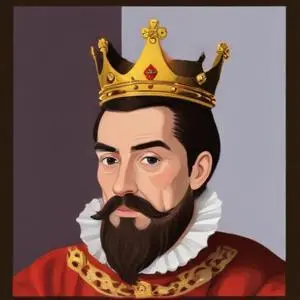
First king of Scotland to also rule England, uniting the crowns of both countries under a single monarch, and known for his efforts to strengthen the Church of Scotland.
James I, King of Scots, is notorious for his dramatic life story, which was marked by captivity, power struggles, and ultimately, assassination. Born in 1394, James would go on to reign as King of Scots from 1406 until his death in 1437, leaving behind a legacy of reform and controversy.
As the youngest son of King Robert III and Annabella Drummond, James' early life was marked by uncertainty and danger. Following the suspicious death of his older brother, David, Duke of Rothesay, James' safety became a pressing concern. In 1406, he was forced to take refuge in the castle of the Bass Rock in the Firth of Forth, only to be captured by English forces and taken to the court of Henry IV of England.
James would spend the next 18 years in English captivity, during which time he received a thorough education and developed an appreciation for English methods of governance. Despite being a prisoner, James was treated relatively well, and his time in England would later influence his approach to ruling Scotland.
In 1420, James joined Henry V of England on military campaigns in France, fighting alongside his captor against Scottish forces. This move would later be seen as a betrayal by some Scottish nobles, who resented James' collaboration with the English.
In 1424, James married Joan Beaufort, daughter of the Earl of Somerset, just before his release from captivity. His freedom was secured through a ransom payment and the provision of Scottish hostages as security.
James' return to Scotland was met with skepticism by some noble families, who were forced to provide heavy taxes to cover the ransom payments and hostages. Despite these challenges, James set about reforming the Scottish government, implementing measures to strengthen the monarchy and reduce the power of the nobility.
James' reign was marked by controversy, including the execution of several nobles and the arrest of others. He also faced opposition from his cousin, Murdoch Stewart, who had long been a rival claimant to the throne.
On February 21, 1437, James I was assassinated while attending a tournament in Perth. The murder was orchestrated by a group of disgruntled nobles, led by Walter Stewart, Earl of Atholl.
Despite the turmoil of his reign, James I left behind a lasting legacy of reform and modernization. His efforts to strengthen the Scottish monarchy and reduce the power of the nobility paved the way for future generations of Scottish rulers.
James I's collaboration with the English during his captivity and his later military campaigns against Scottish forces remain controversial to this day. His execution of nobles and rivalry with his cousin, Murdoch Stewart, further complicated his public image.
Despite these controversies, James I is remembered as a shrewd and ambitious ruler who worked to modernize and strengthen the Scottish monarchy.
Born in 1542
The last Scottish monarch of the House of Stuart, she was a Catholic queen who faced Protestant rebellion and was eventually beheaded, sparking a centuries-long rivalry with England. She's known for her tumultuous reign and tragic fate.
Born in 1926
The monarch of the United Kingdom and its Commonwealth realms, serving as a unifying figurehead and symbol of national identity, while also carrying out various ceremonial and charitable duties.
Born in 1457
First Tudor king of England, who ended the Wars of the Roses and established a strong, centralized government, bringing stability and prosperity to the country.
Born in 1274
Led Scotland during the First War of Scottish Independence, ultimately securing a decisive victory at the Battle of Bannockburn and earning recognition as the country's rightful king. He's celebrated for his bravery, strategic thinking, and unwavering commitment to Scottish freedom.
Born in 1599
Leader of the Parliamentarian forces during the English Civil War, who later ruled England, Scotland, and Ireland as a republican dictator, known for his military victories and radical reforms.
Born in 1643
A 17th-century nobleman who ruled Lorraine and played a significant role in the Thirty Years' War, known for his military campaigns and territorial expansions.
Born in 1512
The King of Scotland who ruled from 1513 to 1542, known for his tumultuous reign marked by conflicts with England and the Catholic Church. He was also a patron of the arts and a romantic figure.
