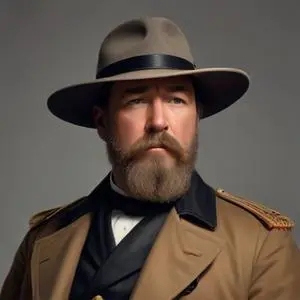
James Longstreet: The Confedrate General and Robert E. Lee's Right-Hand Man
A Legacy of Bravery and Controversy
James Longstreet, a prominent Confederate general, is best known for his unwavering dedication to the Confederate cause and his pivotal role as General
Robert E. Lee's most trusted subordinate during the American Civil War. As a corps commander for the Army of Northern Virginia, Longstreet played a crucial part in many of the Confederacy's most significant battles, earning him the esteemed title of "Lee's Old War Horse."
Early Life and Military Career
Born on January 8, 1821, in Edgefield District, South Carolina, Longstreet graduated from the United States Military Academy at West Point in 1842, ranking 54th out of 62 cadets. He went on to serve in the United States Army during the Mexican-American War, where he was wounded at the Battle of Chapultepec. During his recovery, he married his first wife, Louise Garland, and in the ensuing years, he served on frontier duty in the American Southwest.
The American Civil War
In June 1861, Longstreet resigned his U.S. Army commission and joined the Confederate Army, citing his loyalty to his home state of South Carolina. He commanded Confederate troops during several early battles, including the First Battle of Bull Run, and played a minor role in the Battle of Blackburn's Ford.
Significant Contributions and Controversies
Longstreet's most notable contributions to the Confederate war effort came during the Seven Days Battles, where he helped supervise repeated attacks that drove the Union army away from the Confederate capital of Richmond. He led a devastating counterattack that routed the Union army at Second Bull Run, and his men held their ground in defensive roles at Antietam and Fredericksburg.
However, Longstreet's most controversial service was at the Battle of Gettysburg, where he openly disagreed with Lee on the tactics to be employed. This disagreement has been the subject of much debate among historians, with some arguing that Longstreet's hesitation to attack on the second day of the battle ultimately led to the Confederate defeat.
Post-War Life and Legacy
After the war, Longstreet went on to serve as a diplomat, politician, and businessman. He died on January 2, 1904, and was buried in Gainesville, Georgia.
Personal Life and Relationships
Longstreet married three times, first to Louise Garland, then to Julia Hancock, and finally to Helen Dortch. He had ten children, five with each of his first two wives.
Influence on Modern Society
Longstreet's legacy continues to be felt in modern society, with many historians and military strategists studying his tactics and decisions during the Civil War. His life and career serve as a testament to the complexities and challenges of war, and the importance of loyalty, duty, and honor.
Historical Context and Legacy
In the context of the American Civil War, Longstreet's role as a Confederate general and Lee's right-hand man cannot be overstated. His bravery, tactical prowess, and dedication to the Confederate cause have cemented his place in history as one of the most important and influential figures of the war.
- Longstreet's most notable contributions to the Confederate war effort include the Seven Days Battles, Second Bull Run, Antietam, and Fredericksburg.
- He was known for his disagreements with Lee on tactics, particularly at the Battle of Gettysburg.
- Longstreet served as a diplomat, politician, and businessman after the war.
- He married three times and had ten children.
Comparative Analysis with Contemporaries
When compared to his contemporaries, Longstreet's military career and legacy are often overshadowed by those of Robert E. Lee and
Stonewall Jackson. However, his dedication to the Confederate cause and his pivotal role in many of the war's most significant battles earn him a place alongside these esteemed generals.
Impact on Pop Culture
Longstreet's life and career have been immortalized in numerous books, films, and television shows, including the acclaimed miniseries "Gettysburg" and "Gods and Generals." His story continues to captivate audiences, serving as a testament to the enduring fascination with the American Civil War.
FAQ
What was James Longstreets role in the American Civil War?
James Longstreet was a prominent American general and diplomat who served as one of the most trusted advisors to General Robert E. Lee during the American Civil War. He played a key role in several major battles, including the Battle of Gettysburg and the Battle of Chickamauga.
How did James Longstreets military strategy impact the outcome of the Civil War?
Longstreets military strategy was often at odds with Lees, and he advocated for a more defensive approach. Despite this, he remained loyal to Lee and played a key role in several key battles, including the Siege of Petersburg and the Battle of Appomattox Court House.
What were some of James Longstreets notable accomplishments after the Civil War?
After the Civil War, Longstreet became a prominent figure in Republican politics and was appointed as the United States Ambassador to Turkey by President Ulysses S. Grant. He also wrote a memoir, From Manassas to Appomattox, which provided a detailed account of his experiences during the Civil War.
Who were James Longstreets contemporaries in the Civil War?
Longstreet was a contemporary of notable figures in the Civil War, including General Robert E. Lee, General Ulysses S. Grant, and General William Tecumseh Sherman.
What was James Longstreets legacy in American history?
Longstreets legacy is complex and multifaceted. While he was a prominent figure in the Confederacy, he also became a vocal advocate for reconciliation and reconstruction after the war. His memoir provides a detailed and insightful account of the Civil War from a Southern perspective.