


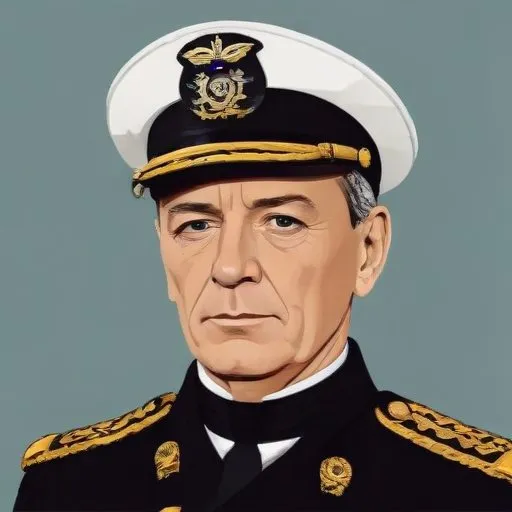
An American naval officer who played a crucial role in the development of the United States Navy's aviation program, serving as the Chief of the Bureau of Aeronautics from 1933 to 1937.
James O. Richardson, a distinguished American naval officer, is renowned for his prescient warning about the vulnerability of the Pearl Harbor naval base, which tragically came to pass in December 1941. Born on September 18, 1878, in Paris, Texas, Richardson graduated from the United States Naval Academy in 1902, fifth in a class of eighty-five.
After completing his studies, Richardson embarked on a storied naval career, with assignments in the Asiatic Squadron, Atlantic Ocean, and later as a member of the first class of the Navy's Post Graduate Engineering School. He went on to command various vessels, including the USS Asheville, and held key positions in the Bureau of Steam Engineering and the Bureau of Navigation.
In 1940, Richardson was appointed Commander-in-Chief of the United States Fleet (CINCUS), a position that gave him oversight of the Pacific Fleet. However, he strongly disagreed with the decision to relocate the fleet's Pacific portion to Pearl Harbor, citing concerns about the base's vulnerability to Japanese attack. Richardson believed that a forward defense was impractical and that the Pacific Fleet would be an attractive target for the Japanese.
Despite his protests, Richardson was relieved of his command in February 1941. Tragically, his concerns were validated just ten months later, on December 7, 1941, when the Japanese launched a surprise attack on Pearl Harbor, drawing the United States into World War II.
Richardson's warnings about Pearl Harbor, though unheeded at the time, have been recognized as a testament to his foresight and expertise. His legacy extends beyond the controversy, as a leader who dedicated his life to the service of his country. Throughout his career, Richardson demonstrated a commitment to the development of the United States Navy, playing a key role in the modernization of the fleet and the improvement of naval operations.
Although Richardson's predictions were initially dismissed, they have since been acknowledged as a valuable lesson in the importance of vigilant military planning and strategic preparedness.
James O. Richardson's life and career spanned a period of significant change and upheaval in world history. From the early years of the 20th century to the aftermath of World War II, Richardson played a key role in shaping the United States Navy and its response to emerging global threats.
In the context of American naval history, Richardson's story serves as a poignant reminder of the importance of strategic foresight, military preparedness, and the sacrifice of those who serve.
Born in 1885
Led the U.S. Pacific Fleet to victory in World War II, playing a crucial role in defeating Japan and ending the war. He was a highly respected and decorated naval leader.
Born in 1886
A highly decorated naval officer who played a crucial role in several key battles in World War II, including the Battle of Midway, and later served as a diplomat.
