


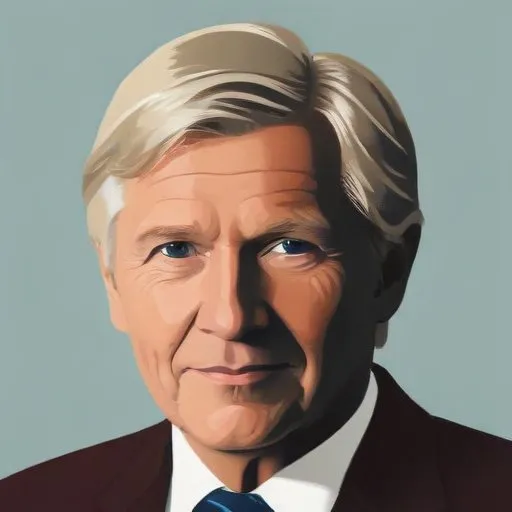
A Norwegian diplomat and humanitarian who has worked with the United Nations and other organizations to promote peace and human rights, particularly in conflict zones. He is known for his advocacy on behalf of refugees and displaced persons.
Jan Egeland is a Norwegian diplomat, political scientist, and humanitarian leader who has dedicated his life to promoting human rights, providing humanitarian aid, and advocating for the marginalized. As the Secretary General of the Norwegian Refugee Council since 2013, Egeland has been at the forefront of providing aid to refugees and displaced people around the world.
Born on September 12, 1957, Egeland hails from a family of politicians. His father, Kjell Egeland, was a Norwegian politician, and Egeland's upbringing instilled in him a strong sense of social responsibility and justice. He attended Stavanger Cathedral School and later pursued a mag.art. in Political Science from the University of Oslo.
Egeland's academic pursuits took him to the University of California, Berkeley, as a Fulbright Scholar, where he wrote a thesis contrasting American and Scandinavian diplomatic models, which was later published as a book. He also held fellowships at the Peace Research Institute Oslo (PRIO) and The Harry S. Truman Research Institute for the Advancement of Peace in Jerusalem.
Egeland's humanitarian work began early, when he campaigned for the disappeared in Chile while still in high school. At 19, he spent a month working for Catholic relief organization Minuto de Dios with the Motilon people in Colombia. This experience laid the foundation for his future work in human rights and humanitarian aid.
Throughout his career, Egeland has held several prominent positions, including:
Egeland's work has had a profound impact on modern society, particularly in the areas of human rights, humanitarian aid, and refugee protection. He has been a vocal advocate for the rights of marginalized communities, including refugees, internally displaced persons, and victims of conflict.
During his tenure as United Nations Undersecretary-General for Humanitarian Affairs, Egeland played a crucial role in coordinating international responses to humanitarian crises, including the 2004 Indian Ocean tsunami and the 2005 Pakistan earthquake.
Egeland's outstanding contributions to human rights and humanitarian aid have been recognized through several awards and honors, including:
Egeland's work is guided by a strong commitment to human rights, social justice, and humanitarian principles. He believes in the importance of protecting civilians in conflict zones and advocating for the rights of refugees and internally displaced persons.
In his own words, "Humanitarian aid is not just about providing assistance, it's about promoting human dignity and upholding human rights."
Throughout his career, Egeland has not been afraid to take risks and challenge the status quo. In 2005, he publicly criticized the international community for its slow response to the Darfur crisis, earning him recognition as a champion of humanitarian causes.
Egeland's dedication to human rights and humanitarian aid has come at a personal cost, including being threatened and harassed by governments and non-state actors. Despite these challenges, he remains committed to his mission of promoting human dignity and protecting human life.
Jan Egeland's work has left an indelible mark on the world of human rights and humanitarian aid. His tireless advocacy, leadership, and commitment to humanitarian principles have inspired a generation of humanitarians and continue to shape the global response to humanitarian crises.
In the words of Egeland himself, "The pursuit of human dignity and human rights is a never-ending task. It requires courage, perseverance, and a willingness to challenge the status quo."
79 Years Old
The 26th Prime Minister of Norway, serving from 1997 to 2000 and again from 2001 to 2005, known for his leadership during a period of significant economic growth and social reform. He's also a Lutheran minister and politician.
67 Years Old
The 27th Prime Minister of Norway and 13th Secretary General of NATO, known for leading Norway's government and the North Atlantic Treaty Organization, shaping global security and economic policies.
87 Years Old
A physician-turned-politician who championed environmental issues and sustainable development, leading the World Commission on Environment and Development. She's credited with popularizing the concept of sustainable development.
68 Years Old
Norwegian Minister of Health who served from 2004 to 2009 and focused on healthcare reform and patient rights. He's known for his efforts to improve healthcare services and accessibility.
66 Years Old
Norway's first female Minister of Finance, known for her progressive policies and efforts to reduce economic inequality. She implemented reforms to increase taxes on the wealthy and reduce poverty.
65 Years Old
The first female Prime Minister of Norway, serving from 2013 to 2021, known for her leadership during the European migrant crisis and her efforts to promote economic growth and climate action.
