


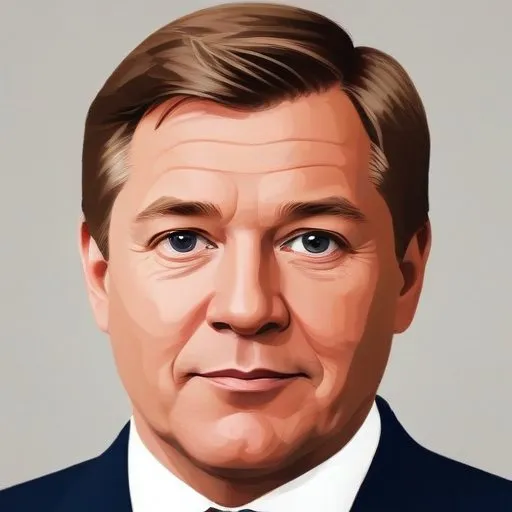
The 26th Prime Minister of Norway, serving from 1997 to 2000 and again from 2001 to 2005, known for his leadership during a period of significant economic growth and social reform. He's also a Lutheran minister and politician.
Kjell Magne Bondevik is a renowned Norwegian Lutheran minister and politician, best known for serving as the 33rd Prime Minister of Norway from 1997 to 2000 and again from 2001 to 2005, making him the second longest-serving non-Labour Party Prime Minister since World War II.
Bondevik was born on September 3, 1947, in Molde, Norway, to Johannes Bondevik, a principal at the Christian folk high school Rauma folkehyskole, and Margit, née Hreid. He became a theological candidate from MF Norwegian School of Theology in 1975 and was ordained as a pastor in the Lutheran Church of Norway in 1979.
Bondevik's political career began at a young age, and he did not serve in the military. He was a member of the Storting (Parliament) from 1973 to 2005, representing the Christian Democratic Party. He served as his party's parliamentary leader in several periods, including 1981-1983, 1986-1989, 1993-1997, and 1999-2000.
In 2008, Bondevik referred to himself as a "68er," indicating his involvement in the radical political movements of the 1960s. He acknowledged being influenced by the radical winds of the time and attempting to radicalize the Young Christian Democrats Norway, much to the dismay of his party.
During his tenure as Prime Minister, Bondevik introduced several significant reforms, including the decentralization of power to local authorities, the promotion of Norwegian language and culture, and the strengthening of the country's social welfare system.
Today, Bondevik serves as the President of the Oslo Centre for Peace and Human Rights, a testament to his commitment to promoting peace, human rights, and social justice.
Bondevik is married to Bjørg Bondevik (née Rasmussen) and has three children: Bjørn (born 1972), Hildegunn (born 1973), and John Harald (born 1976). He is also the nephew of politician Kjell Bondevik, the cousin of former bishop Odd Bondevik, and the brother-in-law of author and priest Eyvind Skeie.
Bondevik's political ideology is deeply rooted in his Christian faith and his commitment to social justice. He has spoken publicly about the importance of balancing individual freedom with social responsibility and promoting greater economic equality.
Bondevik has received several awards and honors for his contributions to politics and human rights, including the Petter Dass Prize in 2003 and the Bridgebuilder Prize in 2006.
Through his remarkable political career and his tireless commitment to promoting peace and human rights, Kjell Magne Bondevik has left an indelible mark on Norwegian politics and beyond.
67 Years Old
The 27th Prime Minister of Norway and 13th Secretary General of NATO, known for leading Norway's government and the North Atlantic Treaty Organization, shaping global security and economic policies.
65 Years Old
The first female Prime Minister of Norway, serving from 2013 to 2021, known for her leadership during the European migrant crisis and her efforts to promote economic growth and climate action.
87 Years Old
A physician-turned-politician who championed environmental issues and sustainable development, leading the World Commission on Environment and Development. She's credited with popularizing the concept of sustainable development.
98 Years Old
The 21st Prime Minister of Norway, serving from 1976 to 1981, known for his efforts to strengthen the country's economy and social welfare system. He played a key role in shaping Norway's oil policy.
Born in 1913
The 18th Prime Minister of Norway, a leader who played a crucial role in shaping the country's post-war economy and foreign policy, particularly in relation to European integration.
