


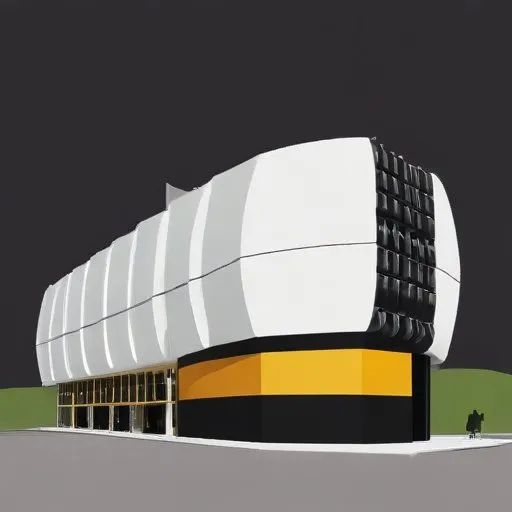
A Czech architect behind the iconic, futuristic Selfridges Building in Birmingham, known for his bold, curvaceous designs that blend functionality with artistic flair.
Jan Kaplick, a Czech-born architect, is renowned for his groundbreaking designs that redefined the urban landscape. His iconic creations, such as the Selfridges Building in Birmingham and the Media Centre at Lords Cricket Ground in London, showcased his unique neofuturistic style, blending futuristic elements with organic forms.
Born on April 18, 1937, in Prague, Czechoslovakia, Kaplick was the only child of a sculptor and a botanical illustrator. Growing up in a suburb of Prague called Oechovka, he developed a passion for art and design. Between 1956 and 1962, he studied at the College of Applied Arts and Architecture and Design VSUP in Prague, earning a Diploma in Architecture.
In the wake of the Prague Spring and the Soviet invasion of Czechoslovakia, Kaplick escaped to London in 1968 with fellow architect Jaroslav Vokoun, carrying only $100 and a few pairs of socks. This dramatic turn of events marked the beginning of his journey in the United Kingdom.
In London, Kaplick initially worked for Denys Lasdun and Partners (1969-1971) and later joined the office of Renzo Piano and Richard Rogers (1971-1973), where he contributed to the design of the Centre Georges Pompidou in Paris.
In 1979, Kaplick founded his own architectural think tank, Future Systems, with David Nixon. This marked the beginning of his independent career, during which he developed his distinctive neofuturistic style.
Kaplick's innovative designs earned him international recognition. Some of his most notable projects include:
Kaplick's contributions to architecture were acknowledged through various awards and honors, including:
Jan Kaplick's innovative designs and neofuturistic style have inspired generations of architects and designers. His work continues to shape the urban landscape, leaving behind a legacy of groundbreaking architecture that pushes the boundaries of modern design.
Kaplick's passing on January 14, 2009, marked the end of an era, but his vision and creative spirit continue to influence the world of architecture.
Kaplick's philosophy on architecture was encapsulated in his own words: "Architecture is not just about building buildings, it's about creating spaces that touch people's lives."
Through his remarkable career, Jan Kaplick left an indelible mark on the world of architecture, inspiring a new generation of designers to push the boundaries of creativity and innovation.
Born in 1902
Pioneering creator of iconic American musicals, blending music, dance, and drama to craft timeless classics like Oklahoma! and The Sound of Music.
75 Years Old
A pioneering female architect who revolutionized building design with futuristic, curvaceous structures, pushing the boundaries of innovation and aesthetics.
97 Years Old
A visionary architect and designer, known for his bold, expressive, and curvaceous structures that defy conventional norms, redefining urban landscapes and pushing the boundaries of art and architecture.
88 Years Old
A renowned architect and engineer, famous for designing iconic skyscrapers that redefine city skylines, such as London's The Shard and New York City's The New York Times Building.
74 Years Old
A renowned architect and engineer, he designed iconic structures like the Athens Olympic Sports Complex, blending functionality with artistic flair. His creations often feature sweeping curves and futuristic elements.
Born in 1917
A renowned architect who designed iconic buildings that blend modernity with cultural sensitivity, leaving an indelible mark on the urban landscape.
Born in 1906
A renowned architect who designed iconic buildings like the IDS Center and PPG Place, blending modernist and postmodern styles to create visually striking landmarks. His work redefined urban skylines and influenced contemporary architecture.
Born in 1886
A pioneering architect who revolutionized modern skyscraper design with sleek, minimalist, and functional buildings that redefined urban landscapes. His iconic creations continue to inspire architects and influence city skylines.
