


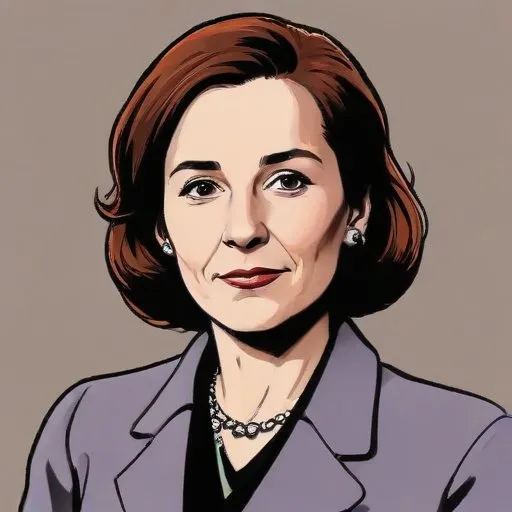
A Canadian-English publisher and politician who championed conservative causes and was a vocal opponent of communism, known for her controversial views and writings. She was a prominent figure in British politics during the 1980s.
Jane Birdwood, Baroness Birdwood, was a prominent British far-right political activist known for being the largest individual distributor of racist and antisemitic material in Britain. Her controversial views and affiliations with extremist groups made her a household name, sparking both fascination and outrage among the British public.
Born Joan Pollock Graham on May 18, 1913, in Winnipeg, Manitoba, Canada, Jane Birdwood's early life was marked by a strong desire to challenge the status quo. The daughter of a singer from Hull and a mother from Newcastle, she moved to Britain with her family at the age of 10 and settled in Yorkshire.
During World War II, Birdwood worked for the Entertainments National Service Association (ENSA), originally in Brussels and later in Hamburg. Her experience in Germany led her to join the Red Cross in 1947, where she met her future husband, Lieutenant Colonel, the Hon Christopher Birdwood, the son of Field Marshal William Birdwood, 1st Baron Birdwood.
In the 1950s, Birdwood became a prominent supporter of the Association of Ukrainians in Great Britain, a group dominated by supporters of the extreme right-wing Organization of Ukrainian Nationalists (OUN). Her association with the OUN's ideology, which emphasized the importance of racial purity, led to her involvement with Yaroslav Stetsko, an OUN leader who had organized a pogrom in Lviv in 1941 that killed thousands of Jews and Poles.
Birdwood's views on race and nationalism sparked widespread controversy, with critics labeling her a racist and an antisemite. Her distribution of racist and antisemitic material, including pamphlets and newsletters, further intensified the debate surrounding her beliefs.
In 1954, Birdwood married Christopher Birdwood, becoming the second wife of the 2nd Baron Birdwood. The couple had no children, and Birdwood's husband succeeded to the title after his father's death in 1951.
Jane Birdwood, Baroness Birdwood, passed away on June 29, 2000, leaving behind a controversial legacy that continues to spark debate among historians and scholars. Her extreme views and affiliations with far-right groups have made her a complex and provocative figure, challenging the boundaries of free speech and tolerance in Britain.
“The only way to achieve true greatness is through racial purity and national unity.”
“The inferior races are holding us back; it's time we take back control of our destiny.”
Jane Birdwood's life and legacy serve as a stark reminder of the dangers of extremism and the importance of promoting tolerance and understanding in society. Her controversial views and actions have sparked a necessary conversation about the limits of free speech and the role of individuals in shaping public opinion.
In conclusion, Jane Birdwood, Baroness Birdwood, remains a complex and thought-provoking figure, challenging our understanding of the far-right movement in Britain and the importance of promoting tolerance and diversity in modern society.
