


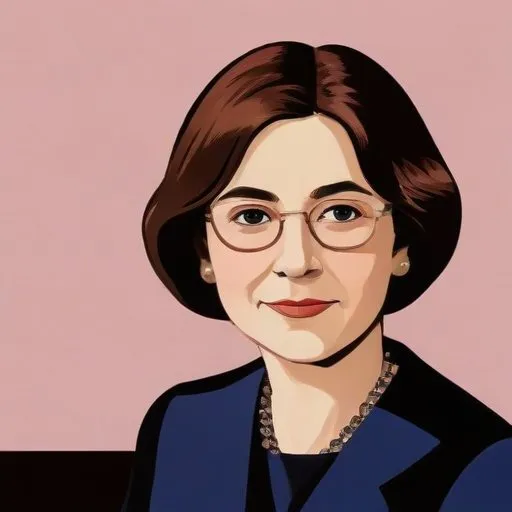
A renowned historian of science, particularly Charles Darwin and the history of evolutionary theory, known for her meticulous research and engaging narrative style.
Janet Browne is a renowned British historian of science, best known for her groundbreaking work on the history of 19th-century biology, particularly her comprehensive biographies of Charles Darwin. Her meticulous research and innovative interpretative approaches have made her a leading authority in the field, earning her numerous prestigious awards and honors.
Janet Browne was born on March 30, 1950, to Douglas Bell CBE and his wife Betty Bell. She grew up in a family that valued education and pursued higher studies with great enthusiasm. Browne earned her BA degree from Trinity College, Dublin in 1972, followed by an MSc from Imperial College, London in 1973, and a PhD in the history of science from Imperial College in 1978.
Browne's academic career is marked by her extensive research on the history of science, particularly in the life sciences, natural history, and evolutionary biology from the 17th to the 20th century. She has published numerous papers, articles, and books, including her seminal two-volume biography of Charles Darwin:
Browne's work on Darwin's correspondence has been widely acclaimed, and her innovative approaches have shed new light on the formation of Darwin's scientific theories and recruitment of scientific support.
Browne's contributions to the field of history of science have been recognized with several prestigious awards, including:
Janet Browne is currently the Aramont Professor of the History of Science at Harvard University, where she continues to teach and conduct research. Her work has had a profound impact on our understanding of the history of science, and her innovative approaches have inspired a new generation of scholars. Browne's legacy as a pioneering historian of science is secured, and her contributions will continue to shape our understanding of the development of scientific thought and its impact on modern society.
Born in 1809
Developed the theory of evolution through natural selection, revolutionizing our understanding of life on Earth. This groundbreaking idea transformed the fields of biology, ecology, and beyond.
Born in 1823
A pioneering naturalist who discovered evolution through natural selection, independently of Charles Darwin, and contributed significantly to the field of biogeography.
Born in 1904
A renowned biologist and ornithologist who pioneered the modern synthesis of evolutionary biology, shaping our understanding of species and their diversity.
84 Years Old
A renowned paleontologist, biologist, and author who challenged traditional views on evolution and natural history through engaging writings and groundbreaking research.
97 Years Old
A renowned biologist and author who has made groundbreaking contributions to our understanding of ecology, evolution, and conservation, and is known for his advocacy for biodiversity and the preservation of natural habitats.
85 Years Old
A renowned evolutionary biologist and science writer, known for popularizing science and advocating for atheism through bestselling books like "The Selfish Gene" and "The God Delusion".
88 Years Old
A Pulitzer Prize-winning author and scientist who explores how geography and environment shape human societies and cultures, known for his groundbreaking book "Guns, Germs, and Steel".
Born in 1920
A pioneering biologist who applied game theory to evolution, shedding light on the strategic nature of natural selection and its role in shaping species' traits.
