


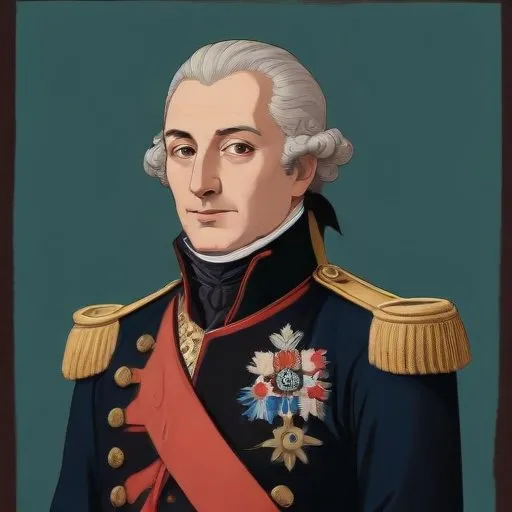
A French general who played a crucial role in the American Revolutionary War, leading French troops to victory alongside George Washington. He's most known for his military strategy and diplomacy.
Jean-Baptiste Donatien de Vimeur, comte de Rochambeau, a name etched in the annals of American history, is renowned for leading the French expeditionary force that played a pivotal role in the Continental Army's victory over the British at Yorktown in 1781. This triumphant collaboration marked a decisive turning point in the American Revolutionary War, securing French support for the American cause and paving the way for the birth of a new nation.
Born on July 1, 1725, in Vendôme, France, Rochambeau was educated at the Jesuit college in Blois. The death of his elder brother led him to enter a cavalry regiment, where he served in Bohemia, Bavaria, and on the Rhine during the War of the Austrian Succession. By 1747, he had attained the rank of colonel, distinguishing himself in the Siege of Maastricht and becoming governor of Vendôme in 1749.
His military prowess was further demonstrated in the Seven Years' War, where he fought in Germany, notably in the Battle of Krefeld and the Battle of Clostercamp, receiving several wounds at Clostercamp. His bravery earned him promotion to Brigadier General of infantry.
In 1780, Rochambeau was appointed commander of land forces as part of the secret project codenamed Expédition Particulière. He was given the rank of Lieutenant General, leading 7,000 French troops sent to join the Continental Army under George Washington. Axel von Fersen the Younger served as his aide-de-camp and interpreter.
Rochambeau's initial reluctance to lead the expedition was due to the small size of the force at his disposal. However, he eventually landed at Newport, Rhode Island on July 10, 1780. The College in the Colony of Rhode Island and Providence Plantations (now Brown University) served as an encampment site for some of his troops. The College Edifice was converted into a military hospital during their stay.
In 1781, Rochambeau's troops marched south to join Washington's forces, culminating in the Battle of Yorktown. The French army played a crucial role in the Continental Army's victory, with Rochambeau's tactical prowess and Washington's strategic genius combining to trap the British army under General Charles Cornwallis.
The subsequent surrender of British forces on October 19, 1781, marked a decisive turning point in the war, paving the way for British recognition of American independence in 1783. Rochambeau's contribution to this victory earned him a place in American history, and his name became synonymous with French-American cooperation and military prowess.
Rochambeau returned to France in 1783, where he was hailed as a hero. He continued to serve in the French army, eventually becoming Marshal of France in 1791. He died on May 10, 1807, at the age of 81, leaving behind a legacy that spanned two continents and shaped the course of modern history.
Jean-Baptiste Donatien de Vimeur, comte de Rochambeau's life and legacy serve as a testament to the enduring spirit of cooperation, bravery, and strategic brilliance. As we reflect on his remarkable achievements, we are reminded of the profound impact that individuals can have on shaping the course of history.
Born in 1757
French aristocrat and military officer who played a key role in the American and French Revolutions, fighting for independence and democracy. He's a symbol of Franco-American friendship and alliance.
Born in 1763
French admiral who commanded the combined French and Spanish fleet during the Napoleonic Wars, ultimately defeated at the Battle of Trafalgar in 1805.
Born in 1769
A French military leader who rose to prominence during the French Revolution and became Emperor of France, known for his military conquests and reorganization of Europe. He is also famous for his Napoleonic Code, which remains a foundation of modern law.
Born in 1755
A key figure in the French Revolution, leading the coup that overthrew Maximilien Robespierre and later serving as a key advisor to Napoleon Bonaparte. He played a crucial role in shaping French politics during a tumultuous period.
Born in 1758
Radical leader of the French Revolution, instrumental in the Reign of Terror, and advocate for the execution of King Louis XVI.
