


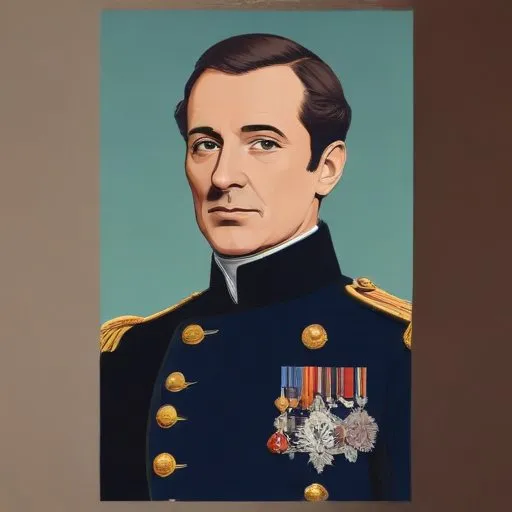
French admiral who commanded the combined French and Spanish fleet during the Napoleonic Wars, ultimately defeated at the Battle of Trafalgar in 1805.
Pierre-Charles Villeneuve is best known for his command of the French and Spanish fleets during the ill-fated Battle of Trafalgar in 1805, where he was defeated by the British fleet led by Horatio Nelson. This pivotal naval battle marked a significant turning point in the Napoleonic Wars, and Villeneuve's leadership has been the subject of controversy and debate among historians.
Villeneuve was born on December 31, 1763, in Valensole, France, and joined the French Navy in 1779. He saw action during the American Revolutionary War, serving as an ensign on the Marseillais in de Grasse's fleet. Despite his aristocratic ancestry, Villeneuve sympathized with the French Revolution and dropped the nobiliary particle from his name, allowing him to continue his service in the Navy while other aristocratic officers were purged.
Villeneuve's military career flourished during the French Revolution and the early years of the Napoleonic Wars. He participated in several battles, earning promotion to rear admiral in 1796. At the Battle of the Nile in 1798, he commanded the rear division, and his ship, Guillaume Tell, was one of only two French ships of the line to escape the defeat.
In 1804, Napoleon ordered Villeneuve, now a vice-admiral stationed at Toulon, to escape from the British blockade, overcome the British fleet in the English Channel, and allow the planned invasion of Britain to take place. However, Villeneuve's plan was thwarted when he was cornered by Nelson's fleet off Cape Trafalgar on October 21, 1805. The French and Spanish fleets were decisively defeated, and Villeneuve was taken prisoner.
Villeneuve's actions at Trafalgar have been subject to intense scrutiny and criticism. Some historians have argued that he was overly cautious and failed to engage the British fleet aggressively enough, while others have pointed to the superior British tactics and gunnery as the primary factors in the French defeat. Whatever the case, Villeneuve's reputation was tarnished by the defeat, and he spent the rest of his life attempting to clear his name.
Villeneuve was known for his intelligence, bravery, and loyalty to Napoleon. He wrote several letters to his family, in which he described the British as "gobelins gras" (greasy goblins). Despite his controversies, Villeneuve remains an important figure in French naval history, and his legacy continues to be debated by historians and scholars.
Born in 1769
A French military leader who rose to prominence during the French Revolution and became Emperor of France, known for his military conquests and reorganization of Europe. He is also famous for his Napoleonic Code, which remains a foundation of modern law.
Born in 1767
A flamboyant and daring cavalry commander who played a key role in Napoleon's military conquests, earning the title of King of Naples.
Born in 1758
A skilled military strategist and one of Napoleon's most trusted generals, known for his victories in the Peninsular War and his role in shaping modern warfare.
Born in 1767
Radical Jacobin leader during the French Revolution, known for his extreme views and role in the Reign of Terror.
Born in 1769
A skilled military strategist and one of Napoleon's most trusted generals, known for his bravery and tactical genius on the battlefield.
Born in 1769
A skilled and fearless military leader, known for his bravery and tactical genius on the battlefield, particularly during the Napoleonic Wars.
Born in 1757
French Revolutionary and Napoleonic Wars general who played a key role in several battles, earning him a Marshal of France title. He's also known for his bravery and tactical genius.
