


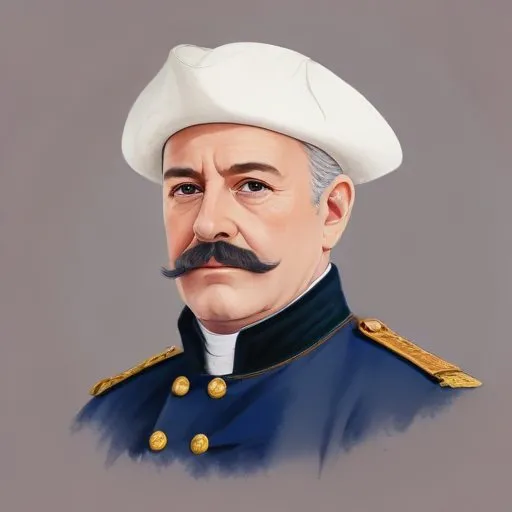
A skilled military strategist and one of Napoleon's most trusted generals, known for his bravery and tactical genius on the battlefield.
Jean Lannes, 1st Duke of Montebello, Prince of Siewierz, was a French military commander and Marshal of the Empire who served during both the French Revolutionary and Napoleonic Wars. He is widely regarded as one of the greatest military commanders in history, known for his daring and exceptional leadership skills, which earned him the respect and admiration of his contemporaries, including Napoleon Bonaparte.
Born on April 10, 1769, in the small town of Lectoure, in the province of Gascony, Southern France, Lannes was the son of a small landowner and merchant. Despite receiving little education, he demonstrated great strength and proficiency in many sports, which led to his election as sergeant-major of the battalion of volunteers of Gers in 1792.
Under the guidance of General Jean-Antoine Marbot, Lannes distinguished himself during the campaigns in the Pyrenees in 1793 and 1794, rising through the ranks to become a chef de brigade. His exceptional conduct and bravery caught the attention of General Jacques Franois Dugommier and future Marshal Louis-Nicolas Davout, who recommended him for promotion.
In 1796, Lannes served under General Barthlemy Louis Joseph Schrer, taking part in the Battle of Loano. However, following the reforms of the army introduced by the Thermidorians, he was temporarily dismissed from his rank. Undeterred, he reenlisted as a simple volunteer in the French army.
Lannes' military prowess and leadership skills soon earned him recognition, and he was reinstated to his former rank. He went on to participate in several key battles, including the Battle of Castiglione in 1796 and the Battle of Aboukir in 1801, where he demonstrated his exceptional bravery and tactical genius.
Lannes was not only an exceptional military commander but also a personal friend of Napoleon Bonaparte. He was one of the few individuals allowed to address the emperor with the familiar "tu," rather than the formal "vous." Napoleon once commented on Lannes, "I found him a pygmy and left him a giant," testament to the high esteem in which he held him.
Jean Lannes' military career was marked by numerous victories and achievements, earning him a place among the greatest military commanders in history. He played a significant role in shaping the course of European history during the French Revolutionary and Napoleonic Wars.
Today, Lannes is remembered as a brilliant and daring military leader who inspired loyalty and admiration from his troops. His legacy continues to influence military strategy and tactics, and his name is revered alongside other great military leaders.
Born in 1769
A French military leader who rose to prominence during the French Revolution and became Emperor of France, known for his military conquests and reorganization of Europe. He is also famous for his Napoleonic Code, which remains a foundation of modern law.
Born in 1767
A flamboyant and daring cavalry commander who played a key role in Napoleon's military conquests, earning the title of King of Naples.
Born in 1770
A renowned military strategist and statesman who played a crucial role in Napoleon's conquests and later became a key figure in French politics, known for his exceptional organizational skills and bravery.
Born in 1758
A skilled military strategist and one of Napoleon's most trusted generals, known for his victories in the Peninsular War and his role in shaping modern warfare.
Born in 1769
A skilled and fearless military leader, known for his bravery and tactical genius on the battlefield, particularly during the Napoleonic Wars.
