


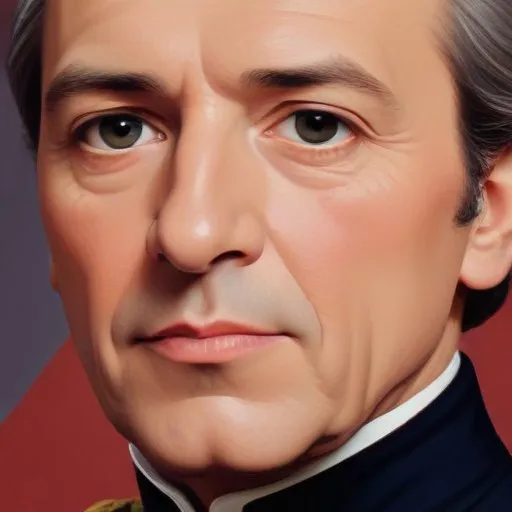
A renowned military strategist and statesman who played a crucial role in Napoleon's conquests and later became a key figure in French politics, known for his exceptional organizational skills and bravery.
Louis-Nicolas Davout, also known as the 1st Prince of Eckmühl and 1st Duke of Auerstaedt, was a renowned French military commander and Marshal of the Empire who served during both the French Revolutionary Wars and the Napoleonic Wars. He earned the nickname "The Iron Marshal" (Le Maréchal de fer) for his exceptional talent in war and his reputation as a stern disciplinarian.
Davout was born on May 10, 1770, in the small village of Annoux, Yonne, to a poor noble family. He was educated in the nearby Brienne-le-Château, which had a military academy, and later transferred to the École Militaire in Paris. He graduated in 1788 and was appointed a sous-lieutenant in the Royal-Champagne Cavalry Regiment.
When the French Revolution broke out, Davout embraced its principles. He distinguished himself at the Battle of Neerwinden in 1793 and was promoted to general of brigade. However, he was removed from the active list due to his noble birth. After divorcing his wife in 1794, he served in the Rhine campaign of 1796 and accompanied General Louis Desaix in the Egyptian expedition of Napoleon Bonaparte.
Upon his return from Egypt, Davout became one of Napoleon's most trusted generals. He played a crucial role in several battles, including the Battle of Austerlitz, where he led the III Corps to victory. This success earned him the title of Marshal of the Empire and the nickname "The Iron Marshal." He continued to serve Napoleon faithfully, participating in many campaigns, including the Battle of Eylau, the Battle of Friedland, and the Battle of Wagram.
Davout's military genius lay in his ability to adapt to different situations and his unwavering discipline. He was known for his exceptional organizational skills, which allowed him to command large armies with ease. His loyalty and obedience to Napoleon were absolute, earning him the respect and admiration of his contemporaries. He is ranked alongside Marshals André Masséna and Jean Lannes as one of Napoleon's finest commanders.
Davout married twice, first to Adelaide Séry and then to Louise-Aimée-Julie de Quélen de Stuer de Caussade. He had six children, including a son who became a general in the French army. Davout's legacy extends beyond his military prowess; he was also a patron of the arts and sciences, supporting artists and intellectuals throughout his life.
Davout's impact on modern warfare is still felt today. His emphasis on discipline, organization, and adaptability has influenced military strategists for centuries. His name is inscribed on the Arc de Triomphe, and he is remembered as one of the greatest military minds in French history. Despite his untimely death on June 1, 1823, at the age of 53, Davout's legacy continues to inspire and educate military historians and enthusiasts alike.
Davout's remarkable career and unwavering dedication to Napoleon and France have cemented his place in history as one of the greatest military commanders of all time. His legacy continues to inspire and educate, serving as a testament to his exceptional talent, discipline, and loyalty.
Born in 1769
A French military leader who rose to prominence during the French Revolution and became Emperor of France, known for his military conquests and reorganization of Europe. He is also famous for his Napoleonic Code, which remains a foundation of modern law.
Born in 1767
A flamboyant and daring cavalry commander who played a key role in Napoleon's military conquests, earning the title of King of Naples.
Born in 1758
A skilled military strategist and one of Napoleon's most trusted generals, known for his victories in the Peninsular War and his role in shaping modern warfare.
Born in 1769
A skilled and fearless military leader, known for his bravery and tactical genius on the battlefield, particularly during the Napoleonic Wars.
Born in 1769
A skilled military strategist and one of Napoleon's most trusted generals, known for his bravery and tactical genius on the battlefield.
Born in 1753
A skilled military strategist and Napoleon's chief of staff, he played a crucial role in many French military victories and was later appointed Minister of Defence. He's known for his exceptional organizational skills and ability to coordinate large-scale military operations.
