


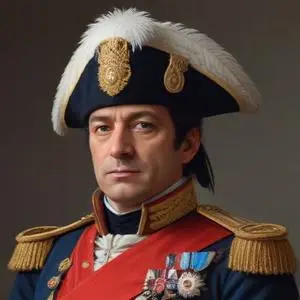
A flamboyant and daring cavalry commander who played a key role in Napoleon's military conquests, earning the title of King of Naples.
Joachim Murat, the Grand Duke of Berg and King of Naples, is renowned for his dazzling military exploits, flamboyant attire, and unwavering loyalty to Napoleon Bonaparte. As one of the most trusted and celebrated generals of the French Empire, Murat's name became synonymous with bravery, tactical genius, and unbridled ambition.
Born on March 25, 1767, in Labastide-Fortunière, southwestern France, Murat's early life was marked by a brief stint in the clergy before he joined a cavalry regiment in 1789, at the outbreak of the French Revolution.
Under the command of General Napoleon Bonaparte, Murat distinguished himself on 13 Vendémiaire 1795, seizing a group of large cannons and playing a crucial role in suppressing the royalist insurrection in Paris. This act of bravery earned him Napoleon's admiration and paved the way for his future successes.
Murat's star continued to rise as he became Napoleon's aide-de-camp and commanded the cavalry during the French campaigns in Italy and Egypt. His unwavering support for Napoleon during the Coup of 18 Brumaire 1799, which brought Napoleon to power, solidified his position as a trusted ally.
In 1800, Murat married Caroline Bonaparte, Napoleon's sister, cementing his ties to the Bonaparte family and further expanding his influence within the French Empire.
In 1806, Murat was appointed Grand Duke of Berg, a title he held until 1808, when he was named King of Naples. Throughout his reign, he continued to serve Napoleon during his Russian and German campaigns, albeit with varying degrees of success.
After Napoleon's downfall, Murat attempted to recover his throne, but was decisively defeated at Tolentino in 1815. He fled to Corsica and eventually made a last-ditch attempt to reclaim his throne, but was taken prisoner by King Ferdinand IV of Naples.
Tried for treason, Murat was sentenced to death and executed on October 13, 1815. Despite his tumultuous later life, Murat's military achievements and unwavering loyalty to Napoleon have secured his place in history as one of the most celebrated generals of the French Empire.
Joachim Murat's life and career provide a fascinating glimpse into the complexities of the French Empire during its heyday. His unwavering loyalty to Napoleon and his military prowess have cemented his place in history, making him an enduring figure of the Napoleonic Wars.
Murat's legacy extends beyond his military achievements, as he played a significant role in shaping the course of European history during the early 19th century. His life serves as a testament to the power of ambition, loyalty, and military genius, making him an integral part of the rich tapestry of French history.
Born in 1769
A French military leader who rose to prominence during the French Revolution and became Emperor of France, known for his military conquests and reorganization of Europe. He is also famous for his Napoleonic Code, which remains a foundation of modern law.
Born in 1769
A skilled military strategist and one of Napoleon's most trusted generals, known for his bravery and tactical genius on the battlefield.
Born in 1770
A renowned military strategist and statesman who played a crucial role in Napoleon's conquests and later became a key figure in French politics, known for his exceptional organizational skills and bravery.
Born in 1758
A skilled military strategist and one of Napoleon's most trusted generals, known for his victories in the Peninsular War and his role in shaping modern warfare.
Born in 1769
A skilled and fearless military leader, known for his bravery and tactical genius on the battlefield, particularly during the Napoleonic Wars.
