


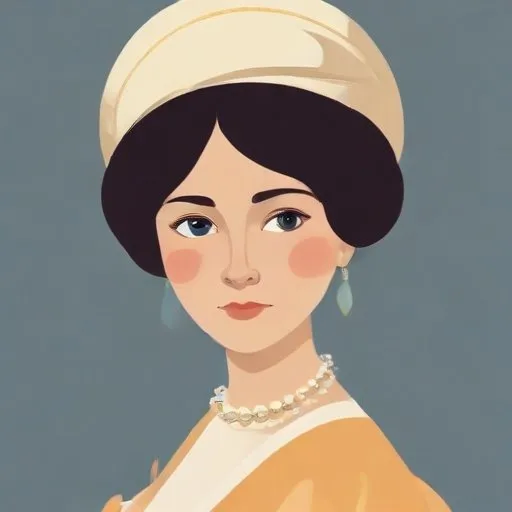
Younger sister of Napoleon Bonaparte, she became Queen of Naples and Sicily through her marriage, playing a significant role in European politics during the early 19th century.
Caroline Bonaparte, the seventh child and third daughter of Carlo Buonaparte and Letizia Ramolino, is best known for being the Queen of Naples and Regent of Naples during the reign of her spouse, Joachim Murat. As the younger sister of Napoleon I of France, she played a significant role in shaping the course of European history.
Born on 25 March 1782, Caroline was educated as a pupil at the school in St-Germain-en-Laye founded by Madame Jeanne Campan, where she attended classes alongside Hortense, Josphine's daughter and Caroline's brother Louis' wife.
In 1793, Caroline moved with her family to France during the French Revolution. She fell deeply in love with the flamboyant and charismatic Joachim Murat, one of her brother's senior cavalry commanders, and they married on 20 January 1800, when Caroline was just seventeen years old.
Initially, Napoleon did not wish to allow them to marry, but his wife Josphine de Beauharnais persuaded him to change his mind. When Napoleon became Emperor, Caroline and her sisters persuaded him to make them Imperial princesses.
Caroline became Grand Duchess of Berg and Cleves on 15 March 1806 and Queen consort of Naples on 1 August 1808, when her husband was appointed to the equivalent positions by her brother. According to the terms of the appointment, she would serve as Regent of Naples during her husband's absence, which she did four times between 1812 and 1815.
Highly regarded for her beauty and intelligence, Caroline was also complex in temperament, ambitious, and politically savvy. Napoleon himself said, "Of all my family, she is the one that resembles me the most."
Caroline left a lasting impact on European history, serving as a queen, regent, and imperial princess. Her life was marked by her intelligence, ambition, and strong will, earning her a place among the most influential women of her time.
Caroline Bonaparte's life and reign took place during a tumultuous period in European history, marked by the French Revolution, the rise and fall of Napoleon's empire, and the reorganization of Europe. Her legacy serves as a testament to the power and influence of women during this time, and her story continues to inspire and fascinate historians and readers alike.
Today, Caroline Bonaparte is remembered as a strong, intelligent, and ambitious woman who played a significant role in shaping the course of European history. Her life serves as a reminder of the importance of women in leadership positions and the impact they can have on the world.
Born in 1769
A French military leader who rose to prominence during the French Revolution and became Emperor of France, known for his military conquests and reorganization of Europe. He is also famous for his Napoleonic Code, which remains a foundation of modern law.
Born in 1780
Napoleon's sister, a beautiful and fashionable woman, was a prominent figure in French high society and a muse for many artists, including the famous sculptor Canova. She was known for her extravagant lifestyle and numerous love affairs.
Born in 1784
The youngest brother of Napoleon Bonaparte, married to a German princess, and briefly King of Westphalia, known for his brief reign and attempts to modernize his kingdom. He's a footnote in Napoleon's shadow.
Born in 1775
French soldier and politician who played a key role in the French Revolution and was the brother of Napoleon Bonaparte, serving as Minister of the Interior and helping to establish the French Consulate. He's also known for his diplomatic and military skills.
Born in 1778
The French-Dutch king who ruled the Netherlands from 1810 to 1813 and is known for his attempts to modernize and centralize the Dutch government. He's also infamous for his authoritarian rule and eventual abdication.
Born in 1746
A Corsican-French lawyer and politician who played a key role in the Corsican independence movement and was the father of Napoleon Bonaparte. He helped draft the Corsican Constitution and fought for Corsican autonomy.
