


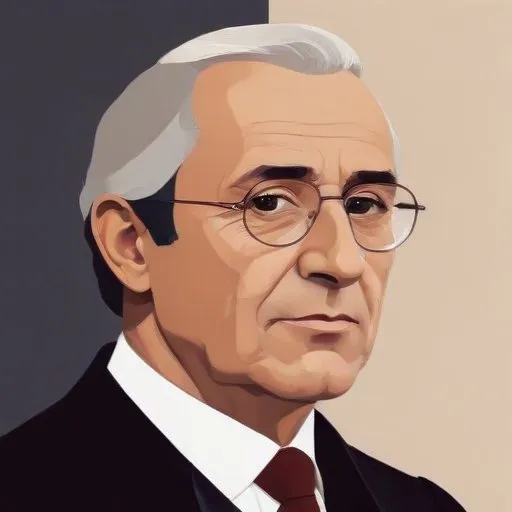
A Corsican-French lawyer and politician who played a key role in the Corsican independence movement and was the father of Napoleon Bonaparte. He helped draft the Corsican Constitution and fought for Corsican autonomy.
Carlo Buonaparte is best known as the father of Napoleon Bonaparte, the legendary French emperor, and grandfather of Napoleon III. This Corsican attorney played a significant role in shaping the course of European history, even if his own accomplishments are often overshadowed by those of his illustrious son.
Born on March 27, 1746, in Ajaccio, Corsica, Carlo was part of a family with Tuscan origins. His ancestor, Guglielmo di Buonaparte, had fled Florence in the 13th century to escape the wrath of the Guelphs faction. Carlo's family eventually settled in Corsica, where they established themselves as a prominent family.
Carlo studied law at the University of Pisa, but left before graduating to tend to his family responsibilities after his father's death. He inherited a substantial amount of wealth, which he used to support his family and further his own ambitions. In 1764, he married 14-year-old Maria Letizia Ramolino, a member of a noble Lombard family, in an arranged marriage that brought further economic convenience and prestige to the Buonaparte family.
Carlo was briefly involved with the Corsican forces, fighting against the Genoese republic under the leadership of Pasquale Paoli. However, when Corsica became part of France, Carlo shifted his allegiance and eventually rose to become Corsica's representative to the court of Louis XVI in 1777. Although he died in 1785, his son Napoleon would go on to become Emperor of the French, granting royal titles to many of Carlo's other children and marrying them off to royalty.
Carlo Buonaparte's influence on modern society is indirect but significant. His involvement in Corsican politics and his connections to the French monarchy paved the way for his son Napoleon's rise to power. Napoleon's reforms and conquests, in turn, shaped European history and left a lasting impact on modern politics, law, and culture.
While Carlo's own philosophical beliefs are not well-documented, his actions suggest a strong sense of family loyalty and duty. His involvement with the Corsican forces and later with the French monarchy demonstrate his willingness to adapt to changing circumstances and pursue opportunities that would benefit his family.
In conclusion, Carlo Buonaparte's life may have been overshadowed by his son's grand accomplishments, but he played a crucial role in shaping the course of European history. His legacy is a testament to the power of family, loyalty, and adaptability in the face of changing circumstances.
Born in 1769
A French military leader who rose to prominence during the French Revolution and became Emperor of France, known for his military conquests and reorganization of Europe. He is also famous for his Napoleonic Code, which remains a foundation of modern law.
Born in 1768
The elder brother of Napoleon, he was a king of Naples and Sicily, and later of Spain, known for his brief but significant reigns in these countries.
Born in 1775
French soldier and politician who played a key role in the French Revolution and was the brother of Napoleon Bonaparte, serving as Minister of the Interior and helping to establish the French Consulate. He's also known for his diplomatic and military skills.
Born in 1784
The youngest brother of Napoleon Bonaparte, married to a German princess, and briefly King of Westphalia, known for his brief reign and attempts to modernize his kingdom. He's a footnote in Napoleon's shadow.
Born in 1780
Napoleon's sister, a beautiful and fashionable woman, was a prominent figure in French high society and a muse for many artists, including the famous sculptor Canova. She was known for her extravagant lifestyle and numerous love affairs.
Born in 1782
Younger sister of Napoleon Bonaparte, she became Queen of Naples and Sicily through her marriage, playing a significant role in European politics during the early 19th century.
Born in 1778
The French-Dutch king who ruled the Netherlands from 1810 to 1813 and is known for his attempts to modernize and centralize the Dutch government. He's also infamous for his authoritarian rule and eventual abdication.
Born in 1763
A Polish military leader who played a key role in the Napoleonic Wars, earning the title of Marshal of France and becoming a national hero. He's revered for his bravery and tactical genius on the battlefield.
