


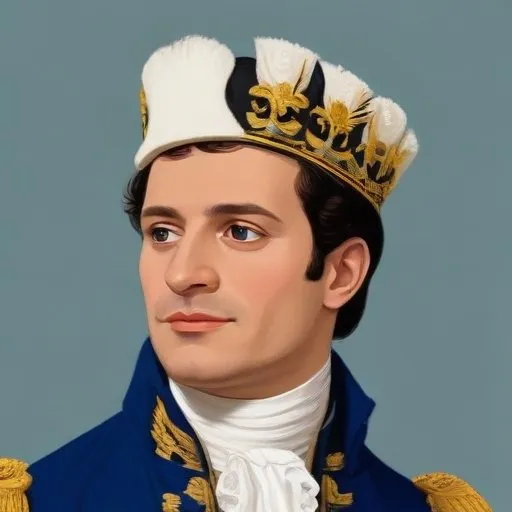
The French-Dutch king who ruled the Netherlands from 1810 to 1813 and is known for his attempts to modernize and centralize the Dutch government. He's also infamous for his authoritarian rule and eventual abdication.
Louis Bonaparte, also known as Louis I of Holland, was a monarch who ruled over the Kingdom of Holland from 1806 to 1810, making him a significant figure in European history. As the younger brother of Napoleon I, Emperor of the French, Louis carved out his own path, earning recognition as a leader in his own right.
Louis was born on September 2, 1778, in Ajaccio, Corsica, to Carlo Buonaparte and Letizia Ramolino. He was the fifth surviving child and fourth surviving son of the family, which included his siblings Joseph, Napoleon, Lucien, and Elisa Bonaparte. Louis' early years were marked by his close relationship with his family, particularly his siblings, who would go on to play significant roles in shaping European history.
Louis' early career was spent in the Army, where he served with distinction alongside Napoleon in the French campaign in Egypt and Syria. His military service earned him a commission in the French Military, thanks in part to Napoleon's patronage.
In 1806, Napoleon established the Kingdom of Holland, appointing Louis as the new king. While Napoleon intended for Holland to be little more than a puppet state, Louis was determined to assert his independence and establish himself as a capable leader.
During his reign, Louis proved to be a popular and effective ruler, earning the respect and admiration of the Dutch people. He worked tirelessly to promote the welfare of his subjects, investing in infrastructure, education, and the economy.
However, Louis' independence and popularity ultimately proved to be his downfall. Growing tired of his brother's wilfulness, Napoleon annexed Holland into the French Empire in 1810, and Louis was forced into exile.
Despite his exile, Louis' legacy endured. His youngest son, Louis-Napoléon, would go on to establish the Second French Empire in 1852, proclaiming himself Napoleon III. Louis' determination to forge his own path and assert his independence would inspire future generations of leaders and politicians.
In 1802, Louis married Hortense de Beauharnais, the daughter of Empress Joséphine, Napoleon's wife. The marriage produced three sons, including the future Napoleon III.
Louis was known for his strong family bonds, and his relationships with his siblings, particularly Napoleon, played a significant role in shaping his life and career.
Louis was a firm believer in the principles of the French Revolution, which emphasized liberty, equality, and fraternity. Throughout his reign, he worked to promote these values, investing in education and social welfare programs.
However, Louis also struggled with the dichotomy between his own ideals and the reality of his brother's authoritarian rule. This internal conflict often left him torn between loyalty to his family and his duty to his subjects.
Louis Bonaparte's legacy is complex and multifaceted. While his reign was marked by turmoil and ultimate exile, he also demonstrated a commitment to his people and a determination to forge his own path.
Today, Louis is remembered as a significant figure in European history, a leader who navigated the complexities of power and loyalty with integrity and compassion.
His story serves as a testament to the enduring power of family, loyalty, and the human spirit, inspiring future generations to strive for greatness in their own right.
Born in 1769
A French military leader who rose to prominence during the French Revolution and became Emperor of France, known for his military conquests and reorganization of Europe. He is also famous for his Napoleonic Code, which remains a foundation of modern law.
Born in 1768
The elder brother of Napoleon, he was a king of Naples and Sicily, and later of Spain, known for his brief but significant reigns in these countries.
Born in 1775
French soldier and politician who played a key role in the French Revolution and was the brother of Napoleon Bonaparte, serving as Minister of the Interior and helping to establish the French Consulate. He's also known for his diplomatic and military skills.
Born in 1767
A flamboyant and daring cavalry commander who played a key role in Napoleon's military conquests, earning the title of King of Naples.
Born in 1769
A skilled military strategist and one of Napoleon's most trusted generals, known for his bravery and tactical genius on the battlefield.
Born in 1758
A skilled military strategist and one of Napoleon's most trusted generals, known for his victories in the Peninsular War and his role in shaping modern warfare.
Born in 1769
A skilled and fearless military leader, known for his bravery and tactical genius on the battlefield, particularly during the Napoleonic Wars.
Born in 1770
A renowned military strategist and statesman who played a crucial role in Napoleon's conquests and later became a key figure in French politics, known for his exceptional organizational skills and bravery.
