


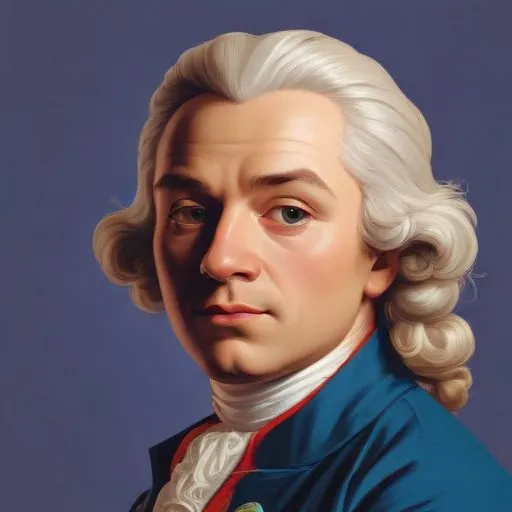
A French painter of portraits and historical subjects, known for his vivid and expressive use of color, capturing the essence of his subjects with sensitivity and nuance.
Jean-Baptiste van Loo was a renowned French portrait painter, celebrated for his striking and faithful likenesses of European aristocrats and nobility. During his illustrious career, he captured the essence of prominent figures, including royalty, nobles, and esteemed patrons, leaving an indelible mark on the art world.
Born on January 14, 1684, in Aix-en-Provence, France, van Loo was instructed in the art of painting by his father, Louis-Abraham van Loo. This early tutelage laid the foundation for his subsequent success, as he went on to work on various projects in Aix and Toulon, showcasing his talent and gaining recognition.
Versions patronage by the Prince of Carignan enabled van Loo to travel to Rome, where he studied under the esteemed Benedetto Luti. This period of study had a profound impact on his artistic style, as he honed his skills and developed a distinctive approach to portraiture. His time in Rome also saw the creation of several exceptional works, including the highly acclaimed Scourging of Christ for the church of Santa Maria in Monticelli.
Versions career was marked by numerous high-profile commissions, as he painted portraits for European royalty and nobility. He was elected a member of the Académie Royale de Peinture et de Sculpture, a testament to his reputation as a master painter. His works during this period included altarpieces and portraits of prominent figures, such as Charles Emmanuel II, Duke of Savoy, and William Murray, who would later become the 1st Lord Mansfield.
In 1737, van Loo traveled to England, where he created several notable portraits, including those of Colley Cibber and Owen McSwiny. His portraits were often engraved in mezzotint by John Faber the Younger, further increasing his visibility and influence. During his time in England, he also painted Sir Robert Walpole, capturing the statesman in his robes as Chancellor of the Exchequer.
Versions health began to decline, and he returned to Paris in 1742, later retiring to Aix-en-Provence, where he passed away on December 19, 1745. Despite his relatively short career, van Loo left an indelible mark on the art world, his portraits continuing to captivate art lovers to this day. His unique style, characterized by striking coloration and unflinching realism, has secured his place as one of the most celebrated portrait painters of the 18th century.
Van Loo's remarkable body of work, which spans multiple continents and royal courts, stands as a testament to his skill and dedication to his craft. As an artist, he played a significant role in shaping the visual identity of European aristocracy, his portraits providing a glimpse into the opulence and grandeur of a bygone era.
Born in 1656
A prominent 18th-century French painter and academic, known for his exquisite portraits of European aristocracy, showcasing remarkable attention to detail and realism.
Born in 1732
A prolific Rococo painter and etcher, renowned for his delicate, whimsical, and often erotic works that capture the carefree spirit of 18th-century French aristocracy. His art often featured lush landscapes, gentle colors, and playful scenes of love and leisure.
Born in 1703
A prominent artist of the Rococo style, known for his delicate and ornate paintings, often depicting mythological and pastoral scenes, as well as designing sets for the Paris Opera.
Born in 1748
A French painter and illustrator who revolutionized Neoclassicism with his realistic and emotive works, creating iconic pieces like "Oath of the Horatii" and "Napoleon Crossing the Alps".
Born in 1659
A prominent portrait painter of the French monarchy and aristocracy, capturing the essence of 17th and 18th century European royalty with exquisite detail and realism.
Born in 1619
A dominant figure in 17th-century French art, he was a painter, art theorist, and director of the Gobelins Manufactory, creating grandiose and dramatic works that epitomized the French Baroque style. He wrote extensively on art theory, influencing generations of artists.
